Get a Free Quote
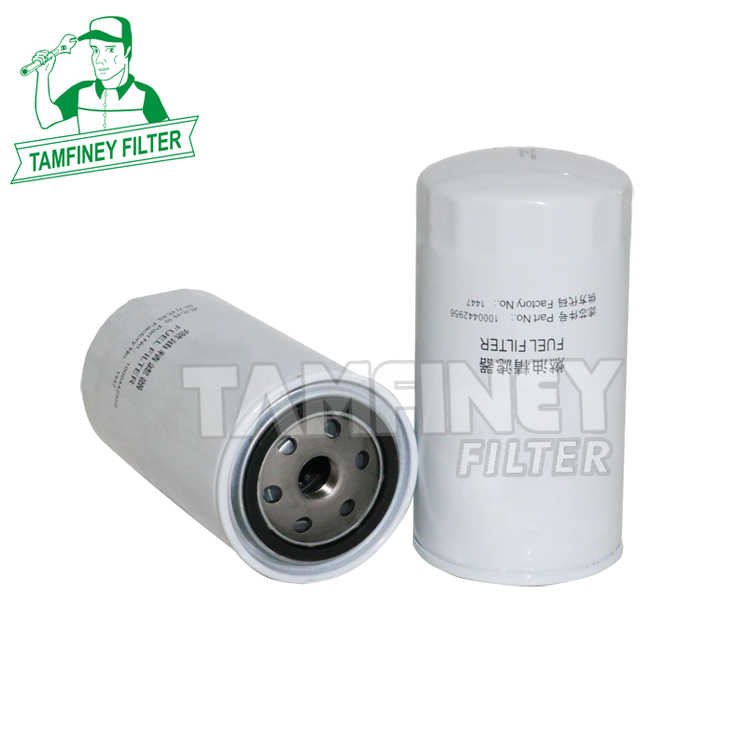
Weichai Fuel Filter 1000442956 612600081334 1000442956A 4110000589001
Your Best Weichai Fuel Filter 1000442956 612600081334 1000442956A 4110000589001 Fuel filter manufacturer in China.
Weichai 1000442956 612600081334 1000442956A 4110000589001 SDLG 4110000589001 CLARCOR Filtration CX0815 FLEETGUARD FF5622 Shangchai D638-002-40 BALDWIN BF9815 Sakura FC-45011


| Fuel Filter 1000442956 612600081334 1000442956A 4110000589001 Parameter: | |
| Part Number | 1000442956 612600081334 1000442956A 4110000589001 |
| Brand | Tamfiney |
| Weight | 734g |
| Height | 170 mm |
| Outer Diameter | 94 mm |
| Inner Diameter/ Thread Size |
M20×1.5 |
| Minimum Order | 100 PCS |
| Place of Region: | Zhejiang, China |
| Payment Terms: | T/T |
| Price Terms: | FOB |
| Lead Time: | 30 to 50 days based on order quantities |
| Market Type: | After Market |
| Current Export Market: | Southeast Asian,North America, South America, Western Europe, Eastern Europe, Africa, Oceania |
What does 1000442956 fit?
FOTON LG 936LG 955LG 956
JAC MOTORS HFC 4251 KR1-Y41HO
KOMATSU GD 655-3EOGD 675-3GD 675-3EO
LOVOL FOTON GROUP FL 956 FFL 956 HFL 958 H
SDLG L 956 FL 968 F
SEM MACHINERY 816
WEICHAI POWER WD 615
XCMG ZL 50 GN
Professional Weichai Fuel Filter 1000442956 612600081334 1000442956A 4110000589001
Q: What is the difference between Yuchai and Weichai filters?
Yuchai and Weichai, as two well-known diesel engine manufacturers in China, have differences in filter design, performance, and applicable scenarios. The main differences are as follows:
1. Filtering technology and standards
Yuchai Filter: The filtration efficiency is calibrated using the "particle counting method", and core performance parameters are scientifically set to ensure that the original filtration efficiency is not less than 90%. It emphasizes no leakage under a pressure of 98kPa (1kg/cm ²) and has passed reliability tests such as vibration and cold and hot cycles.
Weichai Filter: Specific filtration technology standards are not explicitly mentioned in public information, but its filter, as a part of the overall power system, focuses more on matching with high-power engines to meet the continuous filtration needs under heavy load and high-intensity conditions.
2. Applicable scenarios and matching requirements
Yuchai filter: commonly used in mid to low end engines (such as YC6M, YC4F series, etc.), suitable for construction machinery, agricultural machinery, urban distribution logistics and other scenarios, emphasizing low noise, low emissions and economy.
Weichai filter: matched with WP, WJ and other series high-power engines, mainly used in harsh environments such as heavy-duty trucks, mining transportation, and operations in extremely cold areas, emphasizing high reliability and long oil change cycles (up to 100000 kilometers).
3. Durability and maintenance costs
Yuchai filter: accessory prices are 10% -15% lower than Weichai, and maintenance is more economical; Stable performance in urban distribution scenarios with frequent rain, humidity, and start stop.
Weichai filters: have stronger durability under heavy and high load conditions, but slightly higher maintenance costs; Excellent cold start performance (98% success rate at -30 ℃).
4. Market positioning differences
Yuchai: Mainly targeting the mid to low end market, filter design focuses more on cost-effectiveness and daily reliability.
Weichai: Positioned at the mid to high end, the filter emphasizes high-performance matching and long life guarantee.
Q: What is the lifespan of a fuel filter?
The lifespan of fuel filters typically ranges from 20000 to 80000 kilometers, depending on the type of filter, fuel quality, and driving environment.
External fuel filter: It is generally recommended to replace it every 20000 to 30000 kilometers. Due to its exposure to the external environment, it is susceptible to dust and moisture, and the replacement process is relatively simple, resulting in a shorter replacement cycle. If driving in a dusty environment for a long time or using low-quality fuel from non-standard gas stations, it is recommended to shorten the distance to about 15000 kilometers.
Built in fuel filter (integrated into the fuel tank): longer lifespan, usually recommended to replace every 40000 to 80000 kilometers. Due to its enclosed installation location and minimal external pollution, but with high replacement costs, the oil pump assembly needs to be disassembled. It is recommended that it be operated by professionals.
Some high-end or specially designed models: Some have built-in filters that can be extended up to 100000 kilometers, and even claim "lifetime maintenance free", but it still needs to be judged based on actual vehicle conditions.
Key factors affecting the replacement cycle:
Fuel quality: Long term use of high-quality fuels such as Sinopec and PetroChina can extend the cycle appropriately; If the oil quality is poor and there are many impurities, it needs to be replaced in advance.
Driving environment: Frequent driving on dusty, humid, or congested roads can accelerate filter clogging. It is recommended to shorten the replacement mileage.
Time factor: Even if the mileage does not meet the standard, it is recommended to replace it no more than once every 3 years to avoid filter aging and gel deposition causing failure.
Q: Do you need to put diesel in a new fuel filter?
There is no need to directly inject diesel into the new diesel filter for installation. Modern common rail diesel engines have extremely high requirements for fuel cleanliness, and early refueling may cause unfiltered impurities to enter the fuel injector, causing serious damage.
The correct operation steps are as follows:
First, remove the old filter and clean the installation area.
Install the new filter directly onto the filter base, ensuring that the sealing ring is coated with a small amount of diesel to facilitate sealing.
Loosen the air release bolt on the base or oil pump, and release the air by pressing the hand pump (or using an electric pump) until no bubbles emerge and the fuel flows out smoothly.
Re tighten the bleed bolt, start the engine and check for leaks.