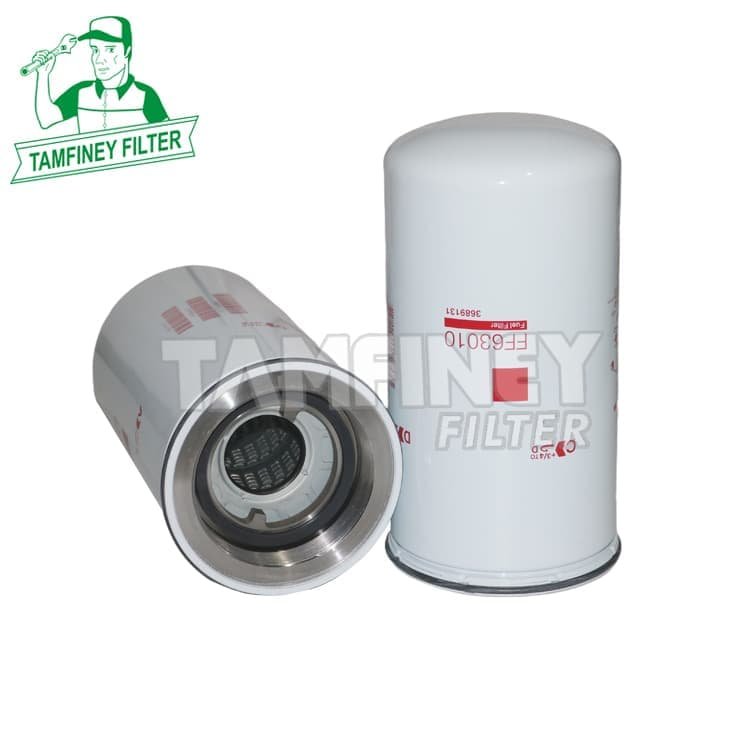



| Secondary Fuel Filter FF63010 RE574467 3689131 60330972 Parameter: | |
| Part Number | FF63010 RE574467 3689131 60330972 |
| Brand | Tamfiney |
| Weight | 2348g |
| Height | 229 mm |
| Outer Diameter | 124 mm |
| Inner Diameter/ Thread Size | M93-10 |
| Minimum Order | 100 PCS |
| Place of Region: | Zhejiang, China |
| Payment Terms: | T/T |
| Price Terms: | FOB |
| Lead Time: | 30 to 50 days based on order quantities |
| Market Type: | After Market |
| Current Export Market: | Southeast Asian,North America, South America, Western Europe, Eastern Europe, Africa, Oceania |
Applications:
• CUMMINS QSM 12 TIER IVQSX 15QSX 15 TIER IV
• DOOSAN DAEWOO 10/455
• HYUNDAI R 480 LC-9AR 520 LC-9A
• JOHN DEERE 6R 5409570 R9570 RT9620 R9620 RX9R 4409R 4909R 5409R 5909R 6409R 6409RX 4909RX 5409RX 5909RX 640
• SANY SY 500
• WIRTGEN W 200 FiW 200 I
Professional Secondary Fuel Filter FF63010 RE574467 3689131 60330972
The Secondary Fuel Filter is essential for protecting any diesel engine. Acting as a crucial line of defense, it ensures that fuel delivered to the engine is clean and free from contaminants. Without a secondary filter, harmful particles and water can reach sensitive engine parts and cause costly damage. Therefore, investing in a high-quality fuel filter is not just a recommendation—it is a necessity.
Efficient fuel filtration is the foundation of engine reliability.
While primary filters block larger debris, only the Secondary Filter can capture the fine particles that threaten injectors and pumps. This added layer of protection ensures engines start smoother, run cleaner, and last longer. Moreover, the filters dramatically reduce maintenance intervals and unexpected breakdowns, thus helping businesses save on costly repairs.
Besides, today’s engines are more sensitive to impurities than ever before. Ongoing innovation in filtration technology has made the Secondary Filter indispensable for modern vehicles and equipment. Advanced multi-layer media inside these filters capture microscopic contaminants, ensuring optimal engine combustion and power output. Furthermore, they help prevent water-related corrosion, especially in high-moisture environments.
Importantly, the Secondary Fuel Filter is easy to fit in various types of machinery,
from trucks and tractors to construction equipment and generators. Their versatility makes them a smart investment for mixed fleets and specialized operators alike. A reliable secondary filter will improve fuel efficiency, cut emissions, and extend engine service life. TAMFINEY provides fuel filters that meet or exceed OEM specifications, so customers can always trust in our quality.
Because secondary filters work in challenging conditions, routine inspection and replacement are vital. Regularly changing your Secondary Fuel Filter keeps the fuel system healthy and your engine performing at its peak. Choosing a reputable brand such as TAMFINEY further guarantees superior filtration performance.
FF63010
The FF63010 is a dependable secondary filter for many vehicles. It meets the highest industry filtration standards, providing efficient protection in harsh conditions.
RE574467
With the RE574467 filter, reliability and compatibility are assured for a wide range of agricultural and industrial engines.
3689131
The 3689131 offers consistent filtration results for fleets requiring flexible and durable fuel filter solutions.
In conclusion, the Secondary Filter is more than just a spare part—it’s your engine’s shield against premature wear and failure. With advanced models like FF63010, RE574467, and 3689131 supplied by TAMFINEY, you ensure clean fuel, strong performance, and maximum equipment uptime. Choose TAMFINEY for your secondary filter needs and experience the advantage of superior filtration and dedicated support.
Q: What is a secondary fuel filter?
The secondary filter, also known as the secondary fuel filter or fine filter, is a key component in the fuel filtration system. It is mainly used to remove small particles, impurities, and moisture from the fuel to protect the precision components of the engine such as injectors and fuel pumps.
In diesel engines, fuel filtration typically adopts a two-stage system: the first stage filter (coarse filter) is responsible for removing large particulate impurities, while the second stage filter serves as the last line of defense, filtering finer pollutants (such as 3-5 micron particles) to ensure that the fuel entering the injection system is highly clean. This design is particularly important for modern fuel systems such as high-pressure common rails, as small impurities may cause component wear or blockage.
The secondary filter is generally installed between the fuel pump and the injector, and operates at higher pressure with higher filtration efficiency. When choosing a suitable fuel secondary filter, factors such as brand, price, and compatibility should be considered.
Q: What is the difference between primary and secondary fuel filters?
In the fuel filter system, the secondary filter and the primary filter are filter components of different levels, and their differences are mainly reflected in the filter level, position, and function.
• Filtration level and efficiency: Secondary filters usually refer to fine filters in fuel systems, responsible for removing smaller impurities with high filtration efficiency, such as reaching 99.5% or more, mainly filtering particulate matter and moisture to protect precision fuel components. The primary filter (or primary filter) focuses on primary filtration, intercepting larger impurities with relatively low filtration efficiency (such as over 80%), serving as a pre filter and reducing the burden on subsequent filters.
• Location in the system:
The secondary filter is generally installed in the rear section of the fuel path, such as in a diesel filter, which is located between the fuel transfer pump and the fuel injection pump as the secondary filtering unit. The primary filter is often located at the front end of the system, such as between the diesel tank and the fuel transfer pump, or at the initial position of the gasoline filter, responsible for filtering the fuel that comes into contact with it first.
• Function focus: The secondary fuel filter pays more attention to deep purification, ensuring the purity of fuel before entering the engine and reducing the risk of fuel injector blockage. The primary filter emphasizes coarse filtration to quickly remove large particulate pollutants, while some designs (such as diesel filters) may integrate moisture separation or preheating functions.
In addition, the fuel filter system may include a safety filter element to prevent dust from entering the engine when the primary filter is damaged, but this does not fall within the scope of secondary or primary filters. The filter structure of different fuels (such as gasoline or diesel) may vary greatly, for example, diesel filters often have multi-stage designs, while gasoline filters are usually single-stage.
Q: Where is the secondary fuel filter located?
The position of the secondary fuel filter (i.e. fuel filter) varies depending on the vehicle model and design, and is mainly divided into two types: internal and external. The following are common installation locations:
Inside the fuel tank: Many vehicles design fuel filters as built-in, directly installed inside the fuel tank, usually integrated with the fuel pump. This type of position is commonly found in gasoline vehicles, making it easier to filter impurities from the fuel before it enters the engine.
Vehicle chassis oil pipe connection: External fuel filters are usually located on the oil pipes of the vehicle chassis, near the fuel tank connection. The vehicle needs to be lifted to view, and this design is easy to maintain and replace.
Interior of engine compartment: Some models may install a secondary fuel filter inside the engine compartment, usually connected to the fuel pipeline for easy inspection and maintenance.
If further confirmation is needed, it can be found along the fuel line from the fuel injector towards the fuel tank. External filters are usually found on the line, while internal filters need to enter the fuel tank area.