
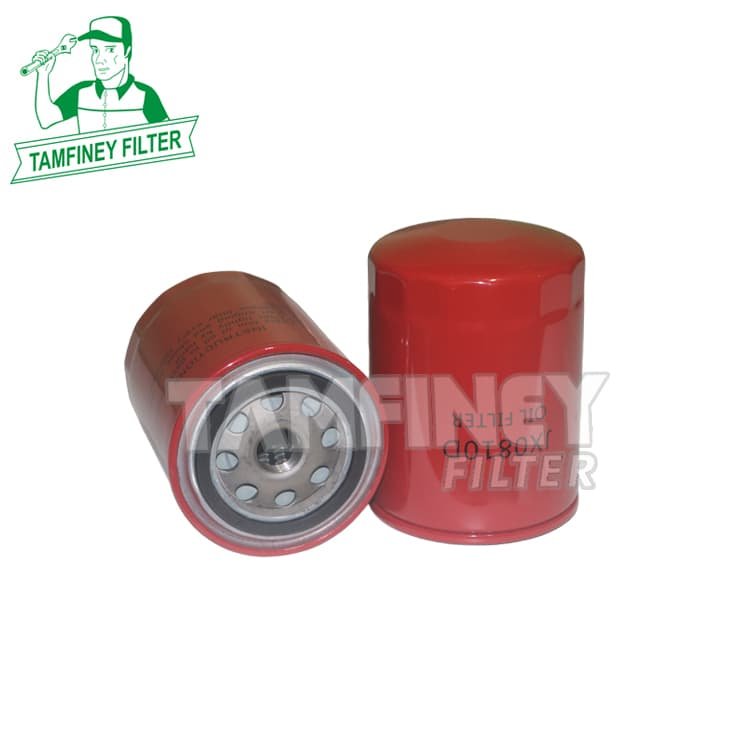



| Oil Filter JX85100C JX85100 B7451 WB202C parameter: | |
| Part Number | JX85100C JX85100 B7451 WB202C |
| Brand | Tamfiney |
| Weight | 592 g |
| Height | 115 mm |
| Outer Diameter | 94 mm |
| Inner Diameter/ Thread Size | M24*2 |
| Minimum Order | 100 PCS |
| Place of Region: | Zhejiang, China |
| Payment Terms: | T/T |
| Price Terms: | FOB |
| Lead Time: | 30 to 50 days based on order quantities |
| Market Type: | After Market |
| Current Export Market: | Southeast Asian,North America, South America, Western Europe, Eastern Europe, Africa, Oceania |
Application:
ITC DHY 11 KSEDHY 9 KEDHY 9 KSEDHY 9 KSEM
LONKING CDM 307-IICDM 308-IICDM 312-II
LOVOL FOTON GROUP M 504
WILSON GEF 16 KVA
Professional JX85100C Spin-on Lube Oil Filter JX85100 B7451 WB202C
Q: What is a spin-on lube filter?
A spin on oil filter is a replaceable assembly consisting of an integral filter element and a housing, which is directly screwed onto the lubrication system interface through threads. It is used to remove metal particles and impurities from engine oil to protect the engine.
Main Definition and Structure
Essence: A disposable replaceable assembly formed by integrating the filter element, bypass valve, check valve, etc. into a sealed steel shell, without the need to replace the filter element separately.
Installation method: The bottom has standard threads and is directly screwed onto the base of the engine or lubrication system. When disassembling, it can be unscrewed and replaced as a whole.
Key components: typically include filter media (paper/synthetic fiber), metal casing, bypass valve (to supply oil when the filter element is clogged), and check valve (to prevent oil leakage during shutdown).
Main Features
Convenient maintenance: During maintenance, only the old parts need to be unscrewed and the new parts need to be screwed on as a whole, without the need for tools to disassemble the internal structure.
Integrated safety: The built-in bypass valve prevents filter blockage from causing oil supply interruption, and the check valve avoids oil backflow and dry grinding after shutdown.
Widely applicable: mainly used in full flow lubrication systems for internal combustion engines such as automobiles, tractors, and construction machinery.
Working principle
Lubricating oil enters from the bottom of the casing under pressure, passes through the filter element to filter impurities from the inside out (or from the outside in, depending on the design), and clean oil enters the engine from the top outlet; When the pressure difference of the filter element is too large, the bypass valve automatically opens to maintain smooth oil flow.
Q: Are spin-on oil filters better?
Spin on oil filters are significantly superior to traditional replaceable filters in terms of convenience and sealing reliability, and are currently the absolute mainstream in the passenger car market. However, whether they are "better" needs to be compared with specific scenarios:
Core Advantages:
Better sealing: The overall integrated design reduces the risk of oil leakage caused by installation errors or missing parts by having only one sealing point.
Easy to replace without disassembling the casing, simply rotate and disassemble, with high maintenance efficiency and less prone to errors.
Stable performance, internally integrated check valve and bypass valve. The filter element is mostly made of high-efficiency filter paper, with high filtration efficiency and low flow resistance, which can effectively protect the engine.
Relatively Limited
High cost: The overall replacement results in a higher cost of consumables per use than the replaceable structure that only replaces the filter element.
Environmental pressure: Waste metal/plastic shells need to be recycled, while replaceable ones only waste filter cartridges, resulting in relatively less solid waste.
Not the only option: Some large diesel engines or special operating conditions still use the combination of "full flow+centrifugal" to meet the demand for small particle filtration
For the vast majority of household vehicles and light engineering vehicles, the rotary type is a better choice as it balances performance, safety, and maintenance efficiency; If pursuing ultimate low cost and having professional maintenance conditions, replaceable models still have value.


