
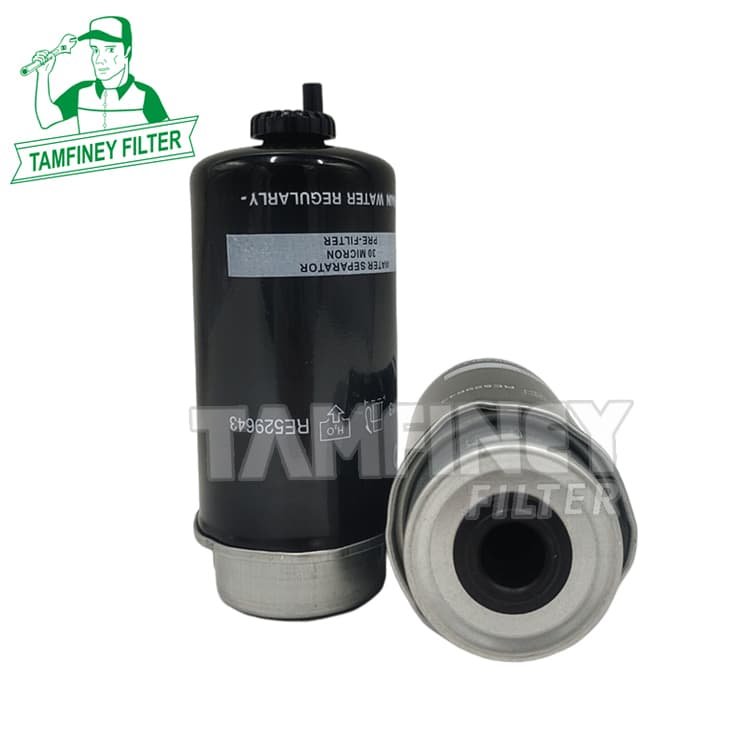


| Fuel Filter RE509036 RE517180 FS19975 Parameter: | |
| Part Number | RE509036 RE517180 FS19975 |
| Brand | Tamfiney |
| Weight | 402g |
| Height | 197 mm |
| Outer Diameter | 83/88mm |
| Inner Diameter/ Thread Size | |
| Minimum Order | 100 PCS |
| Place of Region: | Zhejiang, China |
| Payment Terms: | T/T |
| Price Terms: | FOB |
| Lead Time: | 30 to 50 days based on order quantities |
| Market Type: | After Market |
| Current Export Market: | Southeast Asian,North America, South America, Western Europe, Eastern Europe, Africa, Oceania |
Applications:
• JOHN DEERE 1210 E14704045 HFS 854045 HFS 87473048306068 HFS 856068/HFS86 PowerTech6068 HTJ7630773078307930W 540 CWL 56
LUGGER NL 1064 H23/H33NL 1064 H43NL 1064 T23NL 1066 H23NL 1066 H 33
MAC CORMICK MTX 120 T2MTX 135 T2MTX 150 T2MTX 165 BETA POWER T2MTX 185 BETA POWER T2XTX 145 T2XTX 145 T2XTX 165 T2XTX 165 T2XTX 185 T2XTX 185 T2XTX 185 T3XTX 200 T3XTX 215 T2XTX 215 T3
MENZI-MUCK A 111A 81A 81 MOBILA 91 FA 91 MOBILA 91 VE
Professional John Deere RE509036 Fuel Filter RE517180 FS19975
Q: How to tell if a John Deere fuel filter is bad?
To determine whether the fuel filter of John Deere equipment is bad, you can combine typical fault manifestations of construction machinery and general fuel system diagnostic methods.
1、 Common fault manifestations
• Difficulty or inability to start: Fuel flow is obstructe, resulting in insufficient fuel supply to the engine.
• Decreased power: Weak acceleration, slow response to climbing or heavy loads.
• Idle shaking or stalling: Unstable fuel supply can cause irregular combustion.
• Abnormal increase in fuel consumption: combustion efficiency decreases, requiring more fuel to maintain operation.
• Black smoke emitted from exhaust: Poor fuel atomization and excessive mixture result in incomplete combustion.
• Engine overheating: Insufficient combustion leads to heat accumulation.
• The fuel filter warning light is on (equipped on some models): indicating blockage or excessive moisture.
2、 Visual inspection method
• Appearance inspection: Observe whether there are cracks, deformations, or leaks in the filter housing; Is the connection loose or poorly sealed.
• Fuel condition observation: After removing the filter, if the released fuel is cloudy, contains impurities or moisture, it indicates that the filter element has failed.
• Mileage reference: You can generally replace external filters every 20000-30000 kilometers or 1-2 years; The built-in model can be extended up to 60000 kilometers, please refer to the equipment operation manual for details.
3、 Professional diagnostic advice
• Fuel pressure test: Use a fuel pressure gauge to check the fuel supply pressure. If the pressure is low and fluctuates greatly, it may be due to filter blockage.
• Abnormal noise elimination: If there is a buzzing noise accompanying the fuel tank, it is more likely to be a problem with the fuel pump rather than a clogged filter.
• Consult a professional repair center: If the symptoms are complex or there is a lack of testing tools, it is recommended to go to an authorized service station for professional diagnosis.
⚠️ Attention: John Deere equipment is mostly diesel engines, and its fuel system is more sensitive to moisture and impurities. It is recommended to regularly check the status of the oil-water separator.
Q: How to replace a John Deere fuel filter?
The operation process for replacing the John Deere fuel filter is similar to that of a regular car, but special attention should be paid to the engine type (such as diesel or gasoline) and specific model of its agricultural or landscaping equipment.
• Safety preparation
Park the device on a sturdy, flat surface, turn off the engine, and remove the key.
If it is a diesel engine, it is recommended to release the fuel system pressure: by loosening the bleed screw on the top of the fuel filter or removing the fuel pump relay/fuse, let the engine idle until it stalls, and exhaust the internal fuel in the pipeline.
• Positioning filter
The fuel filter of John Deere equipment is usually located near the engine or under the fuel tank, and some models require access from the bottom or side cover of the equipment.
It is recommended to refer to the maintenance manual of the corresponding model to confirm the specific location and structure (such as some models of filters integrated into the fuel tank).
• Dismantle the old filter
Place a fuel container under the filter to prevent fuel leakage.
Use appropriate tools (such as wrenches, pliers) to loosen the fixing bolts or clamps, and carefully disconnect the inlet/outlet oil pipes.
Pay attention to the direction of the arrow: The old filter is usually marked with a fuel flow arrow, which needs to be recorded for the correct installation of the new part.
• Install a new filter
Confirm that the new filter model is consistent with the old part and check if the sealing ring is intact.
Ensure that the arrow points towards the engine during installation (i.e. the direction of fuel flow is correct).
Reconnect the oil pipe and tighten the fixing bolts to avoid over tightening and damaging the interface.
• Recovery and testing
Reinstall the fuel pump fuse or relay and turn on the power.
Start the engine, observe if it runs smoothly, and check if there is any leakage at the filter interface.
If there are any abnormalities (such as difficulty starting or oil leakage), the machine should be stopped immediately for re inspection.
Q: What is the primary filter effect?
The primary filter effect is the initial interception ability of the first physical barrier against large particulate pollutants. Its core goal is to protect subsequent precision filtration equipment, extend system life, and reduce operating costs, rather than achieving high-precision purification.
The main characteristics of primary filter
• Filter object: mainly intercepts large particles ≥ 5 μ m, such as dust, hair, fibers, sediment, rust, etc.
• Filtration efficiency:According to European standards (EN 779/ISO 16890), it is divided into four levels: G1 to G4;
G1: Filtration efficiency for particles ≥ 5 μ m ≥ 20%;
G4: Efficiency reaches 70% to 90%.
Not suitable for removing:
Dissolvable substances (such as heavy metals and scale);
Small particles (<0.5 μ m), bacteria, viruses, or harmful gases;
Maintenance and lifespan
• Replacement cycle: usually 1-6 months, depending on the dust concentration in the usage environment;
• Washable types: metal mesh, polyester fiber, some G4 filter materials can be washed and reused;
• Disposable type: Paper frame and non-woven filter material need to be replaced regularly to avoid blockage and increase in system resistance.
⚠️ Attention: The primary filter effect is limited and cannot replace medium efficiency, high-efficiency, or deep filters.


