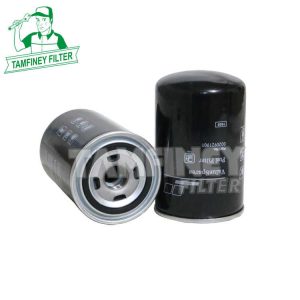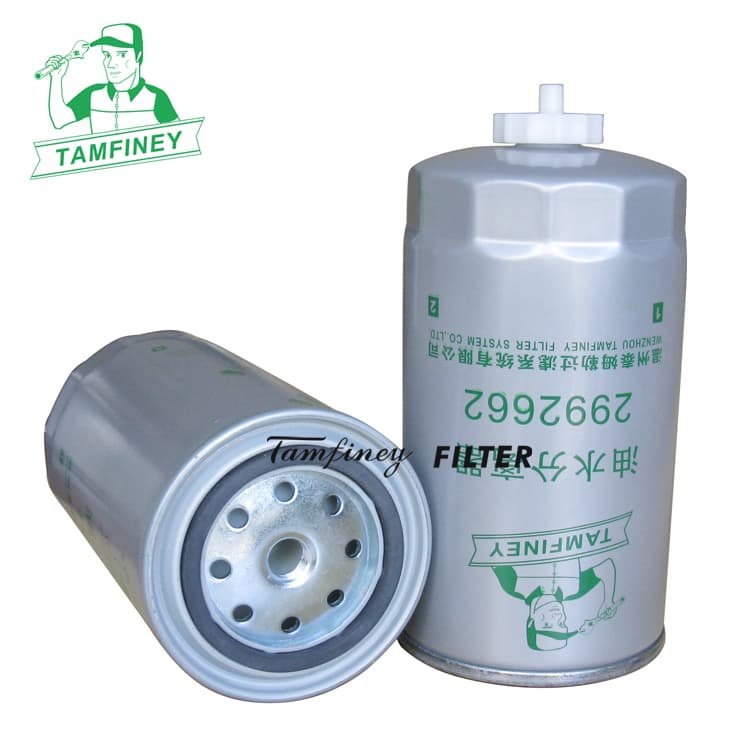



| Fuel Filter 2992662 FS19821 BF1365 Parameter: |
| Part Number | 2992662 FS19821 BF1365 |
| Brand | Tamfiney |
| Weight | 765 g |
| Height | 184 mm |
| Outer Diameter | 96 mm |
| Inner Diameter/ Thread Size | M16 X 1.5 |
| Minimum Order | 100 PCS |
| Place of Region: | Zhejiang, China |
| Payment Terms: | T/T |
| Price Terms: | FOB |
| Lead Time: | 30 to 50 days based on order quantities |
| Market Type: | After Market |
| Current Export Market: | Southeast Asian,North America, South America, Western Europe, Eastern Europe, Africa, Oceania |
Applications:
- IRISBUS GX 327MAGELYS HD 12.2MAGELYS HD 12.2MAGELYS HD 12.8MAGELYS HD 12.8MAGELYS HDH 13MAGELYS HDH 13MAGELYS HDH 13.8MAGELYS HDH 13.8
• IVECO 100 KVAC 13 ENTX20.00A816EUROCARGO II 100E18 K TECTOREUROCARGO II 100E18 TECTOREUROCARGO II 100E22 K TECTOREUROCARGO II 100E22 TECTOREUROCARGO II 100E22 W TECTOR
High Performance Fuel Filter 2992662 FS19821 BF1365
Q: Do performance fuel filters make a difference?
There are significant differences in high-performance fuel filters, mainly reflected in filtration accuracy, adaptability, material technology, and service life. The following are the key differences:
Different filtering accuracies
Ordinary family cars: usually around 20 microns, sufficient to handle impurities during daily driving.
High performance gasoline engine: Recommended 5-20 microns, some can reach 10 microns or even lower, to protect high-precision fuel injectors and in cylinder direct injection systems.
High pressure common rail diesel engine: more stringent requirements, recommended 5-10 microns, to avoid nozzle blockage or wear.
Adaptability and design differences
High performance vehicle models have higher requirements for fuel flow rate and pressure resistance. The filter needs to be matched with the specific fuel pressure, interface form, and installation space of the engine, and cannot be used interchangeably.
For example, in cylinder direct injection (GDI) models require the use of specialized filters with higher filtration accuracy due to higher injection pressure (up to 200-300 bar).
Material and craftsmanship level
Renowned brands such as Bosch and MANN use pure wood pulp paper, fully adhesive paper, or polymer materials, which have high dust holding capacity, good moisture resistance, and high filtration efficiency.
Small brands may use semi adhesive paper or rough craftsmanship, resulting in decreased filtration efficiency and shortened lifespan. Long term use may damage the engine.
Q: When should I replace a high-performance fuel filter?
The replacement cycle of high-performance fuel filters should be comprehensively judged based on the filter type, usage environment, oil quality, and actual vehicle performance.
External high-performance fuel filter
Normal situation: Replace every 20000 to 30000 kilometers.
Poor oil quality or dusty environment: shortened to 10000-20000 kilometers.
Using high-quality gasoline and good road conditions: can be extended up to 30000 kilometers, but should not exceed 40000 kilometers.
Built in high performance fuel filter (usually integrated with the fuel pump)
Normal situation: Replace every 60000 to 100000 kilometers.
Poor fuel quality or frequent congested driving: Check or replace at least 40000 to 70000 kilometers in advance.
High end models (such as Mercedes Benz and BMW): Some claim to be "maintenance free for life", but it is not recommended to blindly trust them. It is recommended to check every 80000 kilometers or so.
Q: Can I use a 10 micron filter for diesel?
A 10-micron filter can be used to filter diesel, but its suitability depends on your vehicle type, engine structure, and operating environment.
• Regular diesel vehicles (mechanical pump system): A 10-micron filter is fully suitable, even falling within a relatively fine filtration range, effectively protecting the fuel system.
• Common rail diesel engine: A 10-micron filter can serve as a coarse filter but typically requires pairing with a finer precision filter (1–5 microns) for optimal performance, as the clearance between mating parts in the common rail system is only 1.5–3.7 microns, and relying solely on a 10-micron filter may not provide sufficient protection.
• For heavy-duty trucks, construction machinery, or harsh environments such as construction sites/mines: A 10-micron filter element can serve as a coarse filter. It is recommended to pair it with a high-efficiency (≥99%) 3–5-micron fine filter and shorten the replacement cycle.
• For light-duty vehicles or favorable road conditions/quality fuel environments: a 10-micron filter element is generally sufficient, as some vehicle models are designed with this precision.
Precautions
• If the manufacturer recommends a 1–5 micron precision filter (as in most modern high-pressure common rail models), the use of a 10 micron filter alone is not advised to avoid affecting engine lifespan.
• 10-micron filters are commonly found in coarse filtration products and are often used for pre-filtration or auxiliary filtration.
The filtration precision should match the fuel system design, as blind replacement may lead to nozzle wear, clogging, or power loss.