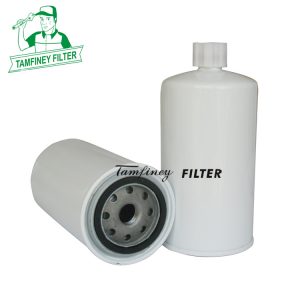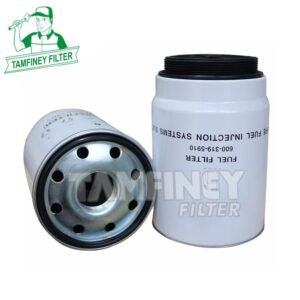


| Fuel Filter FS19816 FS19922 4988297 Parameter: | |
| Part Number | FS19816 FS19922 4988297 |
| Brand | Tamfiney |
| Weight | 1121 g |
| Height | 205 mm |
| Outer Diameter | 118 mm |
| Inner Diameter/ Thread Size | 1" - 14 M32X2.5 |
| Minimum Order | 100 PCS |
| Place of Region: | Zhejiang, China |
| Payment Terms: | T/T |
| Price Terms: | FOB |
| Lead Time: | 30 to 50 days based on order quantities |
| Market Type: | After Market |
| Current Export Market: | Southeast Asian,North America, South America, Western Europe, Eastern Europe, Africa, Oceania |
Applications:
• DONGFENG DFL 1140EQ 3166 GB3GEQ 3166 GB3G
• KING LONG 61206127 E56127 Y6130
Professional FS19816 Spin-On Separator FS19922 4988297
The FS19816 is a premium spin-on separator that guarantees maximum fuel system protection. Engineered for high-performance, FS19816 effectively removes water and contaminants from diesel fuel. Moreover, this separator prevents harmful particles from reaching sensitive injectors. At TAMFINEY, we supply genuine FS19816 separators, helping extend your engine’s service life drastically. Rely on FS19816 for consistent performance, reliability, and peace of mind on every journey.
Spin-On Separator: Advanced Filtration for Modern Engines
A Spin-On Separator is vital for today’s demanding diesel engines, as it keeps fuel clean and engines efficient. Spin-on separators are designed for quick, mess-free installation and easy maintenance. In addition, they offer high contaminant-holding capacity and water-separation effectiveness. TAMFINEY’s line of spin-on separators strictly meets industry standards, providing customers with confidence in every filter change. Whether for agriculture, transport, or construction, spin-on separators deliver superior engine protection.
Why FS19816 Separators Are Crucial for Fleet Operations
Selecting the right separator like FS19816 means fewer engine failures and longer operating intervals. This separator fights injector clogging and corrosion, which are major causes of power loss. As a result, your fleet experiences less downtime and improved longevity. Routine use of FS19816 lowers maintenance costs, maximizing asset value over time. With TAMFINEY’s guaranteed supply, your operation is always ready for demanding schedules.
TAMFINEY: Your Source for Premium Separators
TAMFINEY specializes in providing FS19816, and other spin-on separator solutions for various industries. Our experienced team recommends the best filtration system for your specific needs. Moreover, we offer prompt delivery and comprehensive customer support for every order. Customers trust TAMFINEY to deliver only top-quality, tested products at competitive prices. We help you maintain absolute confidence in your engine’s protection.
Conclusion: Experience Excellence with FS19816 and TAMFINEY
In summary, whether you choose FS19816 FS19922 4988297 spin-on separators, you secure superior filtration performance and reliable engine protection. TAMFINEY’s commitment to quality and customer satisfaction ensures you always receive the best for your equipment. Avoid costly breakdowns and keep your fleet running smoothly with TAMFINEY’s proven separator solutions. Make FS19816 your first choice—trust TAMFINEY for unmatched results in fuel system care.
Q: What happens if I don't drain the water separator?
If the vehicle fuel water separator fails to drain the accumulated water or fuel water mixture in a timely manner, it may cause:
• Difficulty starting or stalling the engine: Excessive accumulation of water can affect fuel supply, and in severe cases, lead to abnormal crankcase pressure and oil emulsification.
• Wear of fuel injectors and high-pressure fuel pumps: Moisture and impurities enter precision components, accelerating wear and even causing strains and jamming.
• Decreased engine power: weak acceleration, black or white smoke emissions, and reduced combustion efficiency.
• Increased carbon deposition: Unsolved moisture and impurities deposit in the intake valve and cylinder, forming hard carbon deposits that affect engine life.
Ice risk (winter): In low temperature environments, water accumulation and freezing can block the oil circuit, leading to fuel supply interruption.
Q: How often should I change the water separator?
There is no absolute standard for the replacement cycle of automotive fuel water separators. The following principles can referre to:
General recommendation for replacement cycle
• Normal situation: Replace every 10000 kilometers or so.
• Synchronize with maintenance: Many suggestions suggest that the fuel water separator should also be replaced every time the oil filter is changed for ease of memory and maintenance.
Key factors affecting replacement cycle
• Fuel quality:
Using high-quality fuel (such as 98 octane gasoline or high-quality diesel), with less impurities and moisture, it can be 12000 to 15000 kilometers.
If you frequently refuel with inferior fuel, it is recommended to shorten it to 8000 kilometers or even shorter.
• Operating environment:
Coastal humid areas: It is recommended to replace it after about 9000 kilometers.
Northern road sections with heavy dust or dust: It is recommended to replace them at 8500-9000 kilometers.
• Vehicle frequency and intensity:
High frequency use (such as taxis and ride hailing services): replacement is required after 8000-10000 kilometers.
Low mileage use of private cars: Even if the mileage is not reached, it is recommended to check it once a year.
How to determine if it needs to be replaced in advance?
• Instrument panel warning light: conical water droplet icon appears (fuel system warning light).
• Abnormal performance of the vehicle:
The engine power decreases, it is difficult to start, and black smoke is emitted.
• Regular inspection: The technician checks the separated moisture and impurity content during each maintenance.
Q: Where is the water separator located?
The position of the fuel water separator in a car varies depending on the model, fuel system design, and engine type, but is usually concentrated in the following areas:
The front end near the fuel tank in the engine compartment: This is the most common installation position, which facilitates preliminary fuel water separation before fuel enters the engine.
On the vacuum tube: Some car models integrate fuel water separators into the vacuum pipeline, using density differences and gravity settling principles to separate moisture.
Between the fuel tank and the fuel pump: fixed at the rear frame of the cab, located on the pipeline between the fuel tank and the fuel pump.
Next to the filter or integrated with the diesel filter: Many diesel vehicles combine the fuel water separator with the diesel filter, usually with a transparent oil storage cup or bottom drain valve visible.
The lowest point or working inlet of the pipeline: At this location, centrifugal force or gravity can be used to more effectively separate fuel water mixtures.
⚠️ Note: Gasoline vehicles generally do not have independent fuel water separators, and this device is mainly used in diesel vehicles.