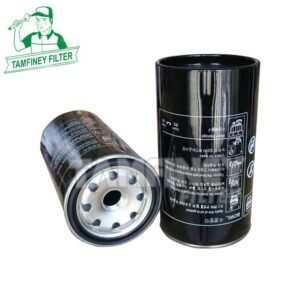

| Fuel Filter VG1540080311 VG1047080011 612600081294 Parameter: | |
| Part Number | VG1540080311 VG1047080011 612600081294 |
| Brand | Tamfiney |
| Weight | 1126 g |
| Height | 230 mm |
| Outer Diameter | 108 mm |
| Inner Diameter/ Thread Size | 1-14 S80X3 |
| Minimum Order | 100 PCS |
| Place of Region: | Zhejiang, China |
| Payment Terms: | T/T |
| Price Terms: | FOB |
| Lead Time: | 30 to 50 days based on order quantities |
| Market Type: | After Market |
| Current Export Market: | Southeast Asian,North America, South America, Western Europe, Eastern Europe, Africa, Oceania |
Applications:
LOVOL FOTON GROUP FL 956 FFL 956 HFL 958 H
XCMG LW 500 K
Professional FAW VG1540080311 Fuel Filter VG1047080011 612600081294
Q: How often should I change a heavy-duty fuel filter?
First and foremost, heavy-duty diesel fuel filters follow clear care rules. You track both mileage and time for proper replacement schedules. The baseline cycle sits at 10000 to 20000 kilometers on roads. You also mark the 6-month to 1-year check window on calendars. Always reference your official vehicle manual for exact guidance. Tweak the plan based on the real quality of your used diesel.
For regular daily use, swap filters at 15000 to 20000 kilometers. This setup fits most standard heavy-duty truck operation cases. If you run premium diesel on smooth routes, extend the interval. Never push the maximum service mileage past 40000 kilometers. Time checks matter even when you cover very low annual miles. Inspect or swap filters every 6 to 12 months without delays. This move stops filter elements from getting damp or aging fast.
Next, most heavy rigs carry two separate fuel filter assemblies. You get a coarse oil-water separator and a fine precision filter. The coarse units need far more frequent drainage or full swaps. Check these separators every 5000 kilometers for trapped water. Stick to the earlier mileage rules for all fine filter changes. To kick things off, low-grade fuel cuts your filter service life. You often refuel at unregulated, small local gas stations.
Local diesel carries large amounts of unseen hard impurities. Shorten the full replacement cycle to 5000 to 10000 kilometers. Tough working conditions also speed up filter wear drastically. You drive nonstop on dusty, muddy construction site roads. Freezing winter temperatures make fuel thick and clog filters. These harsh scenarios force you to swap parts ahead of schedule. Watch for obvious performance drops from your running engine.
Your truck fails to fire up after several ignition attempts. Total power output drops sharply when you pull heavy loads. The whole cab shakes violently when the engine idles steady. Too much trapped water builds up inside the filter housing. The inner filter element turns dark black after short use. Replace the old filter right the moment you spot these issues. All these steps keep your heavy-duty rig running reliably.
Q: Can I use aftermarket filters instead of FAW OEM filters?
It can be replaced, but it is necessary to ensure that the specifications, installation interfaces, and filtering performance are consistent with the original factory. It is recommended to prioritize choosing international OEM suppliers (such as Mahler, Bosch, MAN, etc.) rather than miscellaneous aftermarket parts.
• Physical compatibility: The length, width, height, thickness, and buckle position of the after-sales filter element must fully match the OEM parts of FAW. If there is a slight deviation in size, it may lead to poor sealing (dust leakage) or installation difficulties, affecting the air conditioning airflow and even damaging the air duct.
• Filtration performance: Confirm that the material of the after-sales filter element (such as whether it contains activated carbon for odor removal and PM2.5 filtration efficiency) is not lower than the original factory standard. Some low-priced accessory filter papers have insufficient density, and long-term use may increase engine intake resistance or reduce air quality inside the car.
• Warranty impact: If the vehicle is still within the warranty period and the use of non original parts causes malfunctions in related systems (such as air conditioning blower, engine intake system), the manufacturer may refuse to provide warranty; After the insurance is released, there is no such concern.
Q: Why is water separation so important for diesel engines?
Water separation is crucial for diesel engines, with the core being to prevent water from entering the high-pressure fuel system and causing irreversible mechanical damage, while ensuring combustion efficiency. Diesel itself is not volatile, and modern diesel engines (especially high-pressure common rail systems) require extremely high fuel purity, with moisture being their main "killer".
Protecting precision components from corrosion and wear: The clearance between modern diesel engine fuel injectors and high-pressure fuel pumps is extremely small (in micrometers). Moisture has the characteristics of poor lubricity and easy metal corrosion. Long term mixing can accelerate the sticking of fuel injectors, wear of plunger components, and even cause fracture, resulting in extremely high maintenance costs.
Ensure combustion efficiency and power output: water is non flammable. Mixing water can lead to incomplete combustion, decreased power, idle shaking, and the production of a large amount of white smoke, resulting in excessive emissions.
Avoid mechanical damage caused by liquid impact: water is incompressible. If a large amount of water enters the cylinder with the fuel and cannot be compressed during the compression stroke, it will generate a huge hydraulic impact force (liquid hammer), which may cause the connecting rod to bend, break or the piston top to be damaged, resulting in engine failure.
Prevent low-temperature oil circuit blockage: In cold environments, free water may freeze and block filters or oil circuits; In addition, moisture can easily form emulsions with impurities in the fuel, exacerbating the risk of filter blockage, leading to fuel supply interruption and vehicle collapse.