
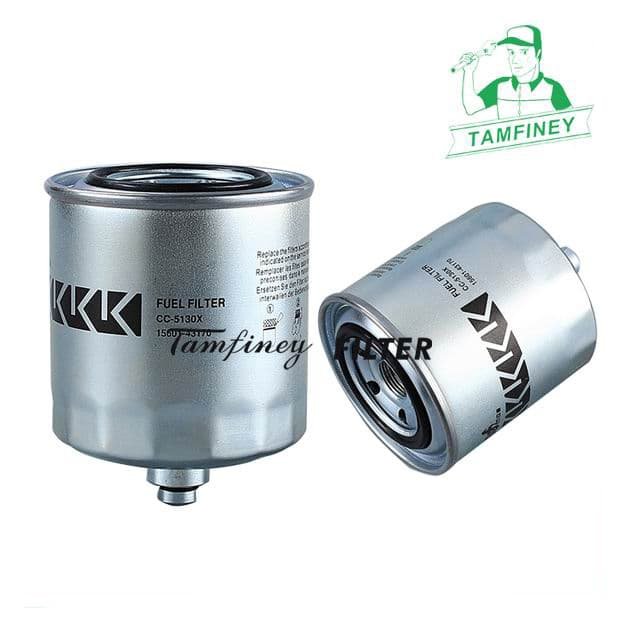


| Diesel Tractor Fuel Filter FF5255 FF5316 15412-86CC0-000 15601-43170 Parameter: | |
| Part Number | FF5255 FF5316 15412-86CC0-000 15601-43170 |
| Brand | Tamfiney |
| Weight | 433 g |
| Height | 120 mm |
| Outer Diameter | 94 mm |
| Inner Diameter/ Thread Size |
M20 x 1.5 |
| Minimum Order | 100 PCS |
| Place of Region: | Zhejiang, China |
| Payment Terms: | T/T |
| Price Terms: | FOB |
| Lead Time: | 30 to 50 days based on order quantities |
| Market Type: | After Market |
| Current Export Market: | Southeast Asian,North America, South America, Western Europe, Eastern Europe, Africa, Oceania |
Applications:
DOOSAN DAEWOO D 10 SD 15 S-2D 18 SD 18 S-2D 20-2D 20 SC-2D 25-2D 30 SD 30 S-2SOLAR 050SOLAR 050 W III
FORD Courier 2.5L WL PD MPFI
KOMATSU FD 20FD 23FD 28FD 35FD 40
KUBOTA GV 3240GV 3240-SWM 4000M 4030M 4030 DTM 4500 DTM 4950M 5030 DTM 5030 DTLM 5030 FM 5030 LM 5030 MDTM 5030 MDTLM 5030 MFM 5030 SUM 5030 SUMDTV 2003 T
Professional Diesel Tractor Fuel Filter FF5255 FF5316 15412-86CC0-000 15601-43170
Q: How often should I change the fuel filter in a diesel tractor?
It is recommended to replace the fuel filter of a diesel tractor every 200 hours of operation.
In addition, considering the usage environment and diesel quality, the following supplementary suggestions can be referred to:
• If diesel with high impurities or non-standard channels is frequently used, the replacement cycle should be shortened. It is recommended to check and replace it every 100-150 hours depending on the situation.
• If the tractor is operated in a high load and dusty environment for a long time, it should also be replaced in advance.
By observing the status of the filter element, it can be used to assist in judgment: if the color of the filter element clearly turns black or there are signs of blockage (such as decreased power or difficulty starting), it should be replaced in a timely manner.
⚠️ Attention: There may be differences in tractor models from different brands. The most accurate replacement cycle should be based on the manufacturer's recommendations in the "Tractor User Manual".
Q: What are the signs of a bad tractor fuel filter?
When the tractor fuel filter is damaged or clogged, it will exhibit a series of abnormal phenomena related to engine fuel supply and combustion.
Power and Performance Performance
• Decreased power: The engine output power weakens, and the tractor becomes noticeably "dull" when operating under load (such as plowing or towing).
• Weak acceleration: The response to rapid acceleration is slow, especially under heavy load conditions where power attenuation is more significant.
• Difficulty in acceleration: The previously easily achievable speed or operating speed becomes difficult to achieve.
Startup and operational stability
• Difficulty starting: The engine start-up time is prolonged, and in severe cases, it may even fail to start.
• Idle shaking: The engine shakes significantly and runs unevenly at idle speed.
• Stuffing/rubbing during driving: Poor fuel supply leads to insufficient combustion of the mixture, causing the body to shake or jerk, especially when going uphill or shifting gears.
• Easy to stall: Frequent automatic stall during idling or driving, especially when shifting gears or changing loads.
Abnormal Fuel System and Emissions
• Abnormal noise or early damage of fuel pump: Filter blockage can cause long-term high-pressure operation of the fuel pump, which may produce abnormal noise or even scrap.
• Increased fuel consumption: The combustion efficiency decreases, requiring more fuel consumption to maintain normal operation.
• Abnormal exhaust emissions:
Black smoke: caused by insufficient fuel combustion.
White smoke: If it is a diesel engine and the oil-water separator fails, water entering the combustion chamber will produce white smoke.
• Fuel leakage: Damaged or improperly installed filter housing may cause fuel leakage.
Q: What happens if you don't use a prefilter?
If a pre-filter (typically a pre-installation filter) is not used, the following impacts will occur:
Failure to install a pre-filter in air compressors or heavy machinery may result in:
• Increased equipment wear: Dust and particulate matter directly enter the equipment, accelerating the wear of components such as impellers and bearings.
• Efficiency decline: Pollutant deposition alters the aerodynamic shape, reducing operational efficiency and increasing energy consumption.
• Increased failure rate: Oil, water, and impurities in compressed air can easily cause pneumatic components to jam or stop, leading to higher maintenance costs.
• Shortened lifespan: The service life of unfiltered equipment significantly decreases under prolonged operation.


