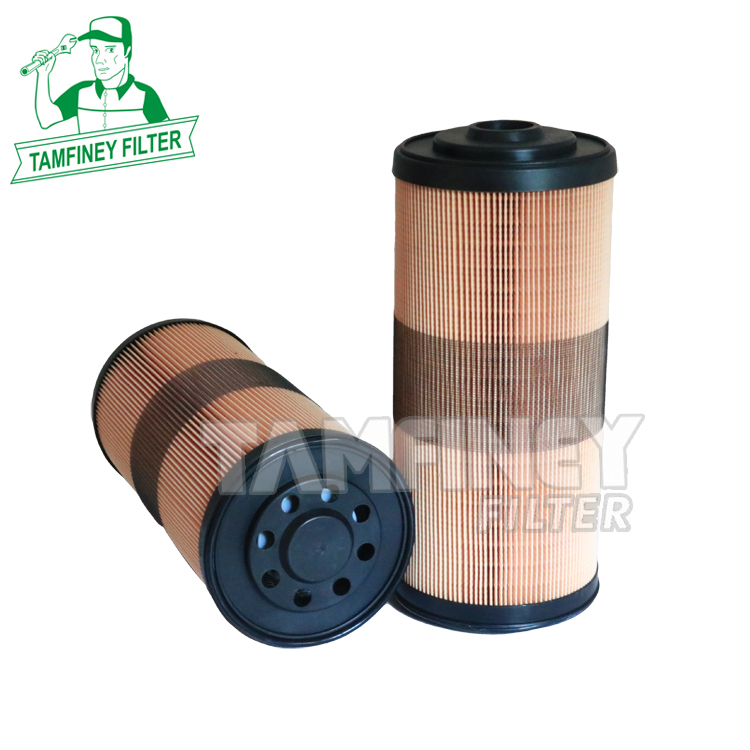



| Fuel Filter FBO 60338 FBO60338 YA00008662 3639672 P581575 Parameter: | |
| Part Number | FBO 60338 FBO60338 YA00008662 3639672 P581575 |
| Brand | Tamfiney |
| Weight | 1807g |
| Height | 335/353 mm |
| Outer Diameter | 152 mm |
| Inner Diameter/ Thread Size |
39mm |
| Minimum Order | 100 PCS |
| Place of Region: | Zhejiang, China |
| Payment Terms: | T/T |
| Price Terms: | FOB |
| Lead Time: | 30 to 50 days based on order quantities |
| Market Type: | After Market |
| Current Export Market: | Southeast Asian,North America, South America, Western Europe, Eastern Europe, Africa, Oceania |
Applications:
Parker FBO-14 sery.
Professional Coalescer Filter Cartridge FBO 60338 FBO60338 YA00008662 3639672 P581575
Q: What are the specifications of the FBO 60338 filter?
The FBO-60338 filter is a coalescing filter element for Racor fuel filtration systems. It’s widely used in ship and generator fuel treatment. Here’s a breakdown of its key specs and features:
Filtration Accuracy: It filters fuel at 25 microns, removing impurities and moisture effectively.
Flow Range: Flow adjusts from 10 to 75 GPM (38–284 LPM), depending on model and fuel type.
Installation Design: The filter uses a locking ring structure. Four bolts connect the housing to the aluminum die-casting filter head. The slotted locking ring collar lets you rotate and replace the element by hand—no special tools needed.
Compatible Models: It works with Racor FBO-14 DPL series water separators, like the FBO-14 DPL-25 Micron.
This filter excels in oil-water separation, efficiently removing water and particles from fuel. That helps keep engines running smoothly.
Q: What types of filters are available in the FBO series?
The FBO series filters mainly offer the following types:
Fuel water separator: used to separate moisture from fuel, such as FBO-10 and FBO-14 models, suitable for scenarios such as fuel trucks and fuel tanks.
Fuel pre filter: used to filter large particulate impurities in fuel, commonly found in diesel fuel distribution systems and aviation kerosene treatment.
Agglomeration filter element: removes tiny water droplets from fuel through agglomeration, suitable for complex fuels such as biodiesel.
Coalescing filter cartridge: specifically designed to adsorb moisture and enhance water separation efficiency, commonly found in the Racor FBO-14 DPL series.
Oil gas separator core: Integrated aggregation and separation functions, used for purifying media such as transformer oil.
These filters are usually made of metal materials and have high temperature resistance and corrosion resistance, making them suitable for harsh environments such as aviation fuel transportation and ship fuel systems.
Q: How does a coalescing filter cartridge work?
The coalescing filter element works by merging tiny droplets into larger ones for separation. It has a multi-layer structure with a filtration layer, a demulsifying coalescing layer, and a separation layer.
Fluid first enters the filtration layer, where solid particles and larger droplets get trapped. Then it moves to the demulsifying coalescing layer, where tiny droplets stick to hydrophilic fibers and merge at intersections. Finally, in the separation layer, hydrophobic or hydrophilic materials selectively capture target droplets while letting the continuous phase pass through.
Key physical mechanisms include inertial impaction, diffusion interception, and direct interception. As fluid flows through tortuous channels, droplets collide with fibers due to inertia. Brownian motion also helps droplets diffuse to fiber surfaces, where they get trapped. Surface tension drives droplet coalescence, merging small droplets into larger ones. Once gravity overcomes fluid resistance, the droplets detach and settle.
The coalescence effect depends on material hydrophilicity/hydrophobicity, fiber pore size gradient, and flow velocity. Hydrophilic materials adsorb water droplets for oil-water separation, while a pore size gradient boosts droplet capture. This principle is widely used in oil-water separation and gas drying, enabling efficient purification without heating or chemicals.