Get a Free Quote
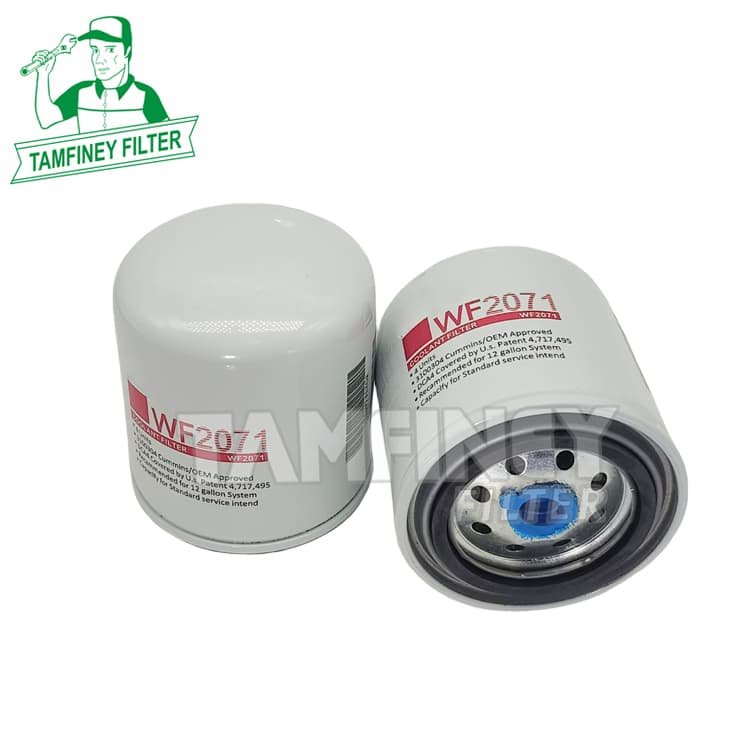
Water Coolant Filters P554071 4099799 WF2051 WF2018 BW5137 9N-3368
Your best Water Coolant Filters P554071 4099799 WF2051 WF2018 BW5137 9N-3368 Coolant filter manufacturer in China.
Donaldson P554071 4099799 WF2051 WF2018 BW5137 9N-3368 ATLAS COPCO-2900512200 ,2900535400 ,5540463900 ;
BALDWIN-BW5138 CATERPILLAR-1112371 ,3I1287 ,3I1289 ,9N3718 ,9Y4526 DETROIT 23508425 FIAT-83957719 ,E7HT8A424BA ,E8NN8A424BB FORD E7HZ8A424A ,E8NN8A424BB ,E8NN8A424CA JOHN DEERE-AR87113 ,AR89380 KOMATSU-6004111010 ,6004111140 ,6004111190 ,6004111191 ,6004111561 ,6134618110 MITSUBISHI-ME065322 ; NEW HOLLAND-47450682 ,E7HT8A424BA ,E8NN8A424BB SAKURA-WC5706 VOLVO-3130939 ,12967020 WHITE-207015001 ,207015004 RENAULT VI-5000808721 ,5001004324 P554744 SAKURA-WC5705 SISU-1696300311 ,1696300451 AGCO 303438430 ,1076751M1
ATLAS COPCO-9772040022 ,13100322A6 ; BALDWIN-BW5073 BOMAG-31701000 CUMMINS 3100306 3315115 ,3316462 ,3316874 ,4058964 ; DAEWOO-991215115 ; DAF-1193926 FLEETGUARD WF2088 WF2051 ,WF2059 WF2152 WF2018 ,WF2052 FORD-F3HZ8A424D HITACHI-4294577 JOHN DEERE-AR87114 ,AR89381 KOMATSU 6004111570 ,6004111571 ,1258389H1 ,1261387H1 ,690171C1 LIEBHERR-5602719 ,7361501 MANN WA9140 ,WA9231 ,WA9233 ,WA9401 ,WA9406 ; MASSEY FERGUSON-1055916M1 ; MCCORMICK-1329039C1 NAVISTAR-1261387H1 ,1801090C1 ,419572C1 ,423870C1 ,427713C1 ,427717C1 ,441365C1 ,462816C1 ,462816C2 ,690171C1 ,993445C1


| Coolant Filter P554071 4099799 WF2051 WF2018 BW5137 9N-3368 Parameter: | |
| Part Number | P554071 4099799 WF2051 WF2018 BW5137 9N-3368 |
| Brand | Tamfiney |
| Height | 107 mm |
| Outer Diameter | 94 mm |
| Inner Diameter/Thread Size | 11/16-16 UN |
| Minimum Order | 100 pcs |
| Place of Region: | Zhejiang, China |
| Payment Terms: | T/T |
| Price Terms: | FOB |
| Lead Time: | 30 to 50 days based on order quantities |
| Market Type: | After Market |
| Current Export Market: | North America, South America, Western Europe, Eastern Europe, Africa, Oceania |
What vehicles does P554071 fit?
NEW HOLLAND 8010T 8020T 8030T 8040T 8050TG 210TG 230TG 255TG 285TJ 275TJ 325TR 86TR 87TR 87TR 88TR 89TR 96TR 97TR 97TR 98TR 99W 270 B
SANDVIK EJC 533 DTTORO 007TORO 1400
SANY TQ 230 H
SDMO 290 KVA450 KVAMS 165 S/SKMS 175 S/SKMS 180 S/SK
TECNOMA LASER 2500LASER 3000LASER 3000 T
VAN HOOL 760 ALIZEE815 ACRON815 ALIZEEA 120A 120A 120 P INTERCITYA 300 LA 300 LA 500AG 700EOS 100EOS 200EOS 90T 812 ALIZEET 815 ACRONT 815 ALIZEE/ACRONT 818 ALTANOT 819 ALTANOT 915 ACRON/ALICRONT 917TD 816 ALTANO/ROYALTD 824 ASTROMEGATD 924TG 821 ACRONTG 822
VOLVO L 280 CTAD 740 GETWD 710 PTWD 710 VTWD 731 VE
VOLVO-PENTA MARINE TAD 1030 G
Professional Water Coolant Filters P554071 4099799 WF2051 WF2018 BW5137 9N-3368
Q: How often should I change my coolant filter?
Let’s clear a common myth about coolant filters first. Most traditional cars have no separate coolant filter. Their cooling systems skip replaceable filter elements. Instead, they use coolant additives for protection. These additives fight corrosion, sediment and scaling.
Some vehicles do come with a coolant filter. High-end and commercial models often include one. Cars using OAT or HOAT coolants may have this part. It catches extra impurities in the cooling system. Its replacement cycle ties to coolant changes usually. Or the manufacturer sets a separate clear schedule.
Replacement suggestions vary by vehicle type. Ordinary household cars need no filter replacement. They simply lack this specific component entirely. Just remember to replace coolant on a regular basis.
If your car has a coolant filter, note these rules. Audi, BMW, Mercedes and heavy trucks often have one. Replace it every 2 years or 40,000 kilometers usually. Do this alongside your regular coolant change. Some models allow longer intervals, up to 4 years. Or you can go 80,000 kilometers before replacement. Always check your vehicle’s Owner’s Manual first. It holds the exact details for your specific car.
Long-term parked cars need special attention too. Even if mileage stays low, don’t ignore time limits. After 3 years, check or replace the filter anyway. Coolant additives lose their effectiveness over time. This makes the filter less able to protect the system.
Q: Why are coolant filters important in diesel engines?
The coolant filter (also known as water filter) plays an important role in diesel engines, mainly reflected in the following aspects:
• Preventing cavitation (bubble corrosion): Metal components in the cooling system of diesel engines, such as the outer wall of cylinder liners, are prone to cavitation under high temperature and pressure due to the rupture of bubbles in the coolant, resulting in gradual peeling or even perforation of the metal surface. The coolant filter contains DCA (diesel engine coolant additive), which can slowly release and form a protective film on the metal surface, effectively suppressing pitting corrosion.
• Filtering impurities and preventing scale: The coolant carries impurities such as rust and sediment during circulation. The coolant filter can physically intercept these particles to prevent blockage of heat dissipation channels or waterways, while reducing scale formation and ensuring heat dissipation efficiency.
• Inhibit corrosion and acidification: The coolant may acidify due to oxidation or pollutants (such as sulfides) during use, corroding components such as water pumps and radiators. Some water filters contain slow-release agents that can neutralize acidic substances and maintain stable pH values in the coolant.
• Improve system reliability: According to the Society of Automotive Engineers (SAE), approximately 50% of engine failures are related to the cooling system, and coolant filters can significantly reduce such risks.
• Extend coolant and engine life: By continuously supplementing additives and filtering pollutants, coolant filters can extend the coolant replacement cycle and reduce abnormal engine wear caused by overheating or corrosion.
In summary, the coolant filter is not only a physical filtration device, but also a chemical maintenance station, which is crucial for ensuring the long-term stable operation of diesel engines.
Q: What are the signs of a bad coolant filter?
Not all vehicles come standard with a coolant filter, but it is used in some diesel engines or specific models to filter impurities in the coolant and prevent blockages in the cooling channels caused by scale, rust, and other debris. If it is damaged or blocked, the following signs may appear:
• Decreased coolant flow: Filter blockage can hinder coolant circulation, resulting in a decrease in system flow rate and affecting heat dissipation efficiency.
• Abnormal increase or fluctuation in pump outlet pressure: Blockage increases fluid resistance, requiring the pump to maintain circulation at higher pressure, which may result in abnormal pressure gauge readings.
• Pump bearing temperature rise: Insufficient cooling intensifies the friction of the water pump bearing, causing the temperature to rise, which may trigger a high temperature alarm.
• Engine overheating or abnormal increase in water temperature: Due to the obstruction of coolant circulation, the heat dissipation efficiency decreases, causing the water temperature gauge pointer to lean towards the high temperature zone, and even triggering the water temperature alarm light.
• The coolant is turbid or contains impurities: the filter fails to filter effectively, and flocs, sediments or turbid foam may appear in the coolant.