
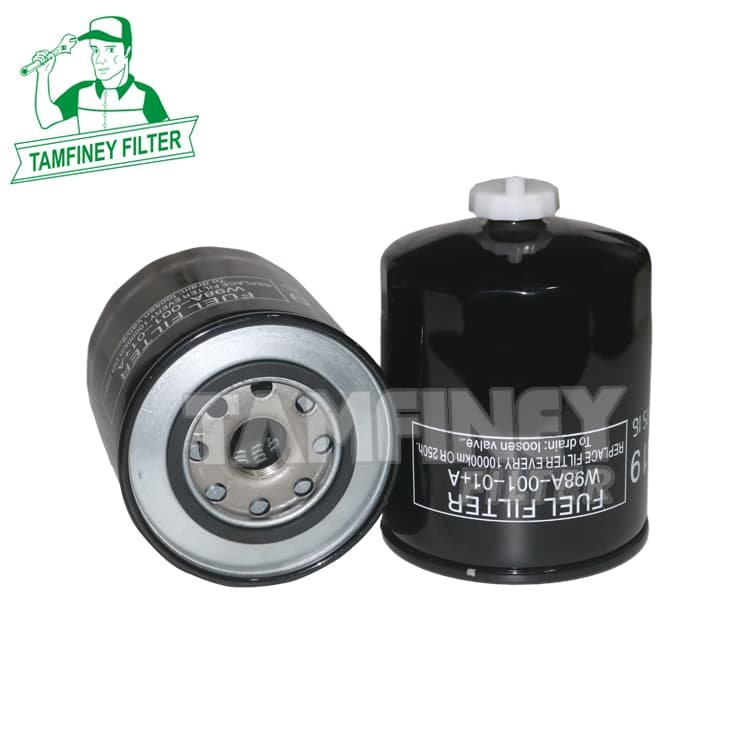



| Filter Cross Reference W98A-001-01+A CX1010B S00031287+02 S00031287 Parameter: | |
| Part Number | W98A-001-01+A CX1010B S00031287+02 S00031287 |
| Brand | Tamfiney |
| Height | 102 MM |
| Outer Diameter | 97 MM |
| Inner Diameter/Thread Size | 1-12 UN |
| Minimum Order | 100 PCS |
| Place of Region: | Zhejiang, China |
| Payment Terms: | T/T |
| Price Terms: | FOB |
| Lead Time: | 30 to 50 days based on order quantities |
| Market Type: | After Market |
| Current Export Market: | North America, South America, Western Europe, Eastern Europe, Africa, Oceania |
Application:
SDEC SC33W, 6KTAA25, SC25K, 6WTAA35, and 12GTAA27
Professional Shanghai Diesel Engine Sc33W Filter W98A-001-01+A CX1010B S00031287+02 S00031287
Q: Is 10 microns good?
10 microns is a length unit often used to describe particle sizes, like PM10. These are inhalable particles 10 microns or smaller.
From a physics standpoint, 10 microns has no inherent "good" or "bad" traits. But in environmental science, it often links to negative effects.
PM10 mainly comes from natural and human sources. Wind dust, traffic exhaust, and industrial emissions all contribute.
When inhaled, these particles settle in the upper respiratory tract. Some get expelled through mucus, but long-term exposure raises respiratory disease risks.
Sensitive groups—like the elderly and kids—face higher danger. Compared to PM2.5, PM10 is less harmful. Larger particles get trapped or cleared by nasal hairs more easily.
Environmental standards use PM10 levels to gauge air quality. The safe limit is usually under 0.5 mg/m³ to protect health.
So in this context, 10 microns ties more to pollution control than benefits.
Q: What will a 5-micron filter catch?
A 5-micron filter can effectively intercept and remove particles with a diameter greater than 5 microns in fluids such as water or air, mainly including visible larger impurities such as sediment, rust, suspended solids, and red worms. Its filtering ability is determined by the pore size, but it cannot filter finer pollutants such as bacteria, viruses, or dissolved substances.
Filtering principle and core capabilities
The filtration accuracy is measured in micrometers (μ m), representing the minimum pore size of the filter element or membrane. The aperture of a 5-micron filter only allows substances smaller than 5 microns to pass through, thereby intercepting particles larger than this size. This type of filtration belongs to physical interception and is suitable for removing suspended solids, but is ineffective against chemical pollutants or microorganisms.
Q: Is changing a fuel filter easy to DIY?
The DIY difficulty of replacing fuel filters mainly depends on the type of filter (external or internal) and the operator's car maintenance experience. Overall, for external filters, DIY is feasible if basic tools and hands-on skills are available; But built-in filters are usually more complex and carry higher risks.
Feasibility and difficulty factors
• External filter: This type of filter is usually located in an easily accessible location such as the engine compartment or chassis, and the replacement steps are relatively simple, including locating the filter, releasing fuel system pressure, disassembling old parts, installing new parts, and checking for leaks. If the operator has some experience and can complete it smoothly, but attention should be paid to fuel spillage and the integrity of the sealing ring.
• Built in filter: Most vehicles have filters built into the fuel tank, which requires disassembling components such as the rear seats and fuel pump assembly. The process is complex and requires specialized tools. Non professional operation may cause fuel leakage or system failure, therefore the risk is relatively high.
Safety precautions and suggestions
• Before operation, it is necessary to ensure that the vehicle is turned off, cooled down, and the negative terminal of the battery is disconnected to avoid short circuits.
• When replacing, it is necessary to release the fuel system pressure (such as loosening the pipeline and listening to a hissing sound), use suitable tools (such as wrenches, filter wrenches), and prepare a fuel container to prevent contamination.
• After installation, carefully check all connections for leaks and start the vehicle for testing operation.
• If you are not familiar with the process or if the vehicle has a built-in filter, it is recommended to have it handled by a professional to ensure safety.


