
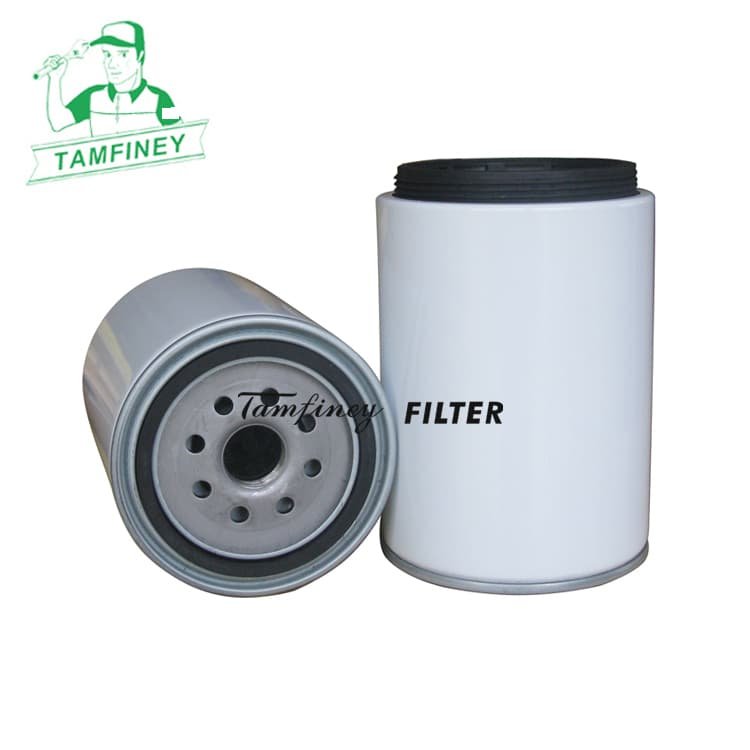


| Fuel Filter 1393640 P551855 P551767 Parameter: | |
| Part Number | 1393640 P551855 P551767 |
| Brand | Tamfiney |
| Weight | 845g |
| Height | 155mm |
| Outer Diameter | 108mm |
| Inner Diameter/ Thread Size | 1-14 3 3/4-10 BUTT |
| Minimum Order | 100 PCS |
| Place of Region: | Zhejiang, China |
| Payment Terms: | T/T |
| Price Terms: | FOB |
| Lead Time: | 30 to 50 days based on order quantities |
| Market Type: | After Market |
| Current Export Market: | Southeast Asian,North America, South America, Western Europe, Eastern Europe, Africa, Oceania |
Applications:
• SCANIA G 94G 94K 114K 114K 124K 124K 94 EB/IB/UBL 94L 94N 94 EB/IB/UBN 94 EB/IB/UBOMNICITY 11OMNICITY 12OMNICITY 18OMNILINE 11OMNILINE 12OMNILINE 18OMNILINK 11OMNILINK 12OMNILINK 18P 114P 124P 124P 124P 124P
• SDMO R 450 KR 550 K/C 2
Professional Scania 1393640 P551855 P551767 Fuel Water Separator
Currently, European transport industry faces increasing fuel quality challenges daily.
Therefore, fleet operators desperately seek reliable Scania fuel filter solutions immediately. Moreover, stringent emission regulations require superior filtration performance from commercial vehicles. However, standard filters cannot meet these demanding environmental requirements consistently. Subsequently, 1393640 emerges as the preferred choice among professional drivers worldwide. Nevertheless, market competitors struggle to match this filter's proven reliability record. Furthermore, independent testing confirms 1393640 outperforms alternatives by significant margins regularly. Meanwhile, transport companies report substantial cost savings after switching products. Consequently, market share continues expanding across European commercial vehicle segments. Also, aftermarket demand grows exponentially due to proven performance benefits. Besides, OEM partnerships strengthen 1393640 position in competitive markets globally. Thus, market leadership reflects genuine customer satisfaction and trust consistently.
Real-World Performance Stories from Professional Fleet Operators
Specifically, long-haul truckers share remarkable experiences with 1393640 installations recently. Hence, drivers notice smoother engine operation during extended highway journeys. Additionally, P551855 compatibility allows quick replacements at service stations conveniently. Furthermore, fuel consumption decreases noticeably after installing authentic Scania fuel filter. Meanwhile, maintenance intervals extend significantly compared to previous filter brands. Therefore, operational downtime reduces dramatically for time-sensitive delivery schedules consistently. Moreover, 93297277 cross reference simplifies parts ordering for independent mechanics. Consequently, customer testimonials highlight improved reliability during critical transport missions. Also, fleet managers document fewer emergency roadside repairs annually. Besides, driver satisfaction increases when equipment performs reliably throughout seasons. Thus, real-world feedback validates 1393640 superiority over competitive alternatives conclusively.
Industry Challenges Solved by Advanced 1393640 Technology
Particularly, modern diesel fuel contains higher biodiesel percentages creating filtration challenges. However, 1393640 handles these fuel composition changes effectively without performance loss. Similarly, water contamination increases with ethanol-blended fuels in storage tanks. Nevertheless, superior water separation technology prevents injection system damage completely. Furthermore, microbial growth threatens fuel quality during extended storage periods. Meanwhile, antimicrobial properties in Scania fuel filter prevent bacterial contamination issues. Therefore, contemporary fuel challenges require advanced filtration solutions like 1393640. Additionally, extreme temperature variations affect filter performance in harsh climates. Moreover, this filter maintains consistent efficiency across temperature ranges reliably. Consequently, operators avoid seasonal performance variations that plague inferior products. Also, compatibility with various fuel additives ensures versatile application possibilities.
Economic Impact Assessment for Transport Companies
Remarkably, total cost analysis reveals significant savings with 1393640 implementation. Therefore, initial investment returns quickly through reduced maintenance expenses annually. Moreover, fuel efficiency improvements generate substantial savings over operational lifecycles. Additionally, P551855 and 93297277 sourcing options optimize procurement budgets effectively. Furthermore, extended service intervals reduce labor costs for busy maintenance departments. Meanwhile, prevented breakdowns eliminate expensive roadside assistance calls consistently. Consequently, profit margins improve when equipment operates reliably without interruptions. Also, insurance premiums decrease with documented reliability improvements over time. Besides, resale values increase for well-maintained vehicles using genuine components. Thus, comprehensive economic analysis supports 1393640 investment decisions conclusively.
TAMFINEY Market Position and Customer Service Excellence
Essentially, TAMFINEY understands evolving market demands for 1393640 solutions completely. Therefore, strategic partnerships ensure continuous product availability during peak seasons. Moreover, competitive pricing strategies make premium Scania fuel filter affordable globally. Additionally, rapid delivery networks serve customers across international markets efficiently. Furthermore, technical expertise supports proper application selection for diverse operations. Meanwhile, customer service representatives provide multilingual support throughout purchasing processes.
Conclusion: Experience TAMFINEY's 1393640 Market Leadership
Ultimately, market trends confirm 1393640 represents the industry's future direction. Therefore, join successful operators choosing TAMFINEY for authentic Scania solutions. Moreover, discover why P551855 and 93297277 compatibility adds exceptional value. Consequently, contact TAMFINEY today for comprehensive 1393640 consultation services immediately.
Q: How to change fuel filter on diesel truck?
Replacing the fuel filter on a diesel truck is an important maintenance operation that can effectively protect the engine. The following is a detailed guide based on common steps, but the specific operation may vary depending on the vehicle model. It is recommended to refer to the vehicle manual.
Preparation
• Safety protection: Wear anti-static gloves and goggles, keep away from sources of fire. Disconnect the negative terminal of the battery to prevent static electricity from igniting fuel vapors.
• Tool preparation: Prepare tools such as wrench, screwdriver, oil cup, sealing gasket, lubricating oil (such as Vaseline), etc. Some car models may require specific specification tools (such as 10mm wrenches or 18mm sockets).
• Release fuel system pressure: Unplug the fuel pump fuse or disconnect the power supply, then start the engine until it stalls naturally to avoid fuel splashing during disassembly.
Disassemble the old filter
• Positioning filter: Usually located near the engine compartment or fuel tank, it may require a jack to lift the vehicle for operation.
• Dismantling process: Place an oil cup under the oil pipe, remove the installation bolts of the old filter and the oil pipe connection. Pay attention to recording the direction of the fuel flow arrow (usually marked with an arrow on the filter housing). There may be a small amount of diesel leakage during disassembly, which needs to be collected properly.
Install a new filter
• Cleaning and lubrication: Clean the installation area and remove residual impurities. Apply a small amount of lubricating oil (such as Vaseline) on the O-rings at the top and bottom of the new filter element to ensure sealing.
• Install filter element: Align the new filter with the position, tighten it clockwise by hand for 2-3 turns, and then use a wrench to tighten it to the recommended torque. Ensure that the filter element is oriented correctly (arrow pointing towards the engine).
• Connect the pipeline: Reconnect the fuel pipe and sensor plug (if any), tighten the clamp to prevent leakage.
Follow-up check
• Exhaust and Start: When using for the first time, loosen the exhaust bolt on the top of the filter, start the engine until the fuel flows out smoothly (without bubbles), and then tighten the bolt.
• Test for leaks: After starting the vehicle, carefully check for fuel leaks at the connections. If there is a leak, the sealing ring needs to be rechecked and adjusted.
Precautions
• Replacement cycle: Diesel filters are usually replaced every 20000 to 30000 kilometers or 2 years, but if driving in environments with high dust or poor oil quality for a long time, it is recommended to shorten the cycle.
• Special scenario: If the vehicle is equipped with the original coarse filter, attention should be paid to whether the pipeline is bypassed or adjusted when replacing it to avoid increasing fuel resistance.
• Professional assistance: If encountering difficulties during operation (such as built-in filters or complex circuits), it is recommended to consult professional maintenance personnel to ensure safety.
Regularly replacing the fuel filter can prevent nozzle blockage and damage to the high-pressure fuel pump, making it a cost-effective maintenance measure.
Q: How to start a diesel after changing the fuel filter?
Starting the diesel engine after replacing the fuel filter may require some additional steps to ensure the proper functioning of the fuel system, especially removing air from the system and establishing oil pressure. The following are operational suggestions and troubleshooting strategies based on common situations:
Preparation and operation steps before startup
1. Check installation and exhaust
Confirm installation in place: First, ensure that the fuel filter is installed correctly, including the sealing ring is intact and the fastening nuts are tightened as required to prevent fuel leakage or air ingress.
Exhaust is key: After replacing the filter, air may enter the fuel system, causing difficulty in starting. Exhaust operation is required for the system.
Find the bleed nut (or exhaust valve) on the fuel filter housing.
a. Loosen the bleed nut and repeatedly press the manual fuel pump (usually integrated on the coarse filter if the vehicle is equipped) or turn on the ignition switch (ON) to let the fuel pump work for a few seconds until the fuel flowing out from the bleed nut is continuous and bubble free.
b. Ensure that there is no fuel leakage during the exhaust process, and tighten the bleed nut after the exhaust is completed.
2. Establish oil pressure and start attempts
Before starting, you can turn the key to the "ON" position multiple times (connect the power but do not start the engine), hold for a few seconds, let the fuel pump establish oil pressure for the system, and then try to start again.
If the vehicle is equipped with a manual oil pump, it can be continuously pressed until the oil circuit feels full and all air is expelled.
3. Observation after startup
After successful start-up, let the engine idle for a period of time to completely exhaust any residual air in the low-pressure oil circuit and ensure stable operation.
Check for leaks in the fuel filter and connections.
Common causes and solutions for difficulty starting after replacement
If the startup is still difficult after following the above steps, it may be due to the following reasons:
• New filter element needs adaptation period: The newly replaced filter element may require the engine to travel a short distance to adapt, and the starting performance may gradually improve.
• Installation issue: If the problem persists after exhaust, it may be due to improper installation of the filter element (such as not installing the sealing ring or tightening the nut) causing air leakage, or a mismatch in the fuel filter model. In this case, it is necessary to recheck the installation.
• Other component failures: If the above conditions are eliminated and the difficulty in starting still exists, it may be due to problems with the fuel pump, injector, or other related components. It is recommended to contact professional maintenance personnel for inspection in a timely manner.
Summary suggestions
To ensure a smooth startup, we suggest that you:
Prioritize following the exhaust steps: Exhaust is the most critical step after replacing the filter, please be patient until the discharged fuel is completely bubble free.
Maintain patience: give the vehicle a brief adaptation process.
Safety first: Keep away from open flames during operation and take measures to prevent leaks. If you are not familiar with the operation or the problem cannot be solved, seeking professional help is the safest choice.
Q: What happens if you don't prime a diesel fuel filter?
After installation or replacement, diesel filters usually require "filling" or "exhausting" operations to ensure that there is no air in the fuel system. If this step is ignored, it may lead to the following problems:
• Difficulty or inability to start: When air is mixed into the fuel system, the fuel pump may not be able to establish sufficient oil pressure, making it difficult to start the engine or immediately shutting down after starting.
• Insufficient engine power or weak acceleration: Air blockage can affect the smooth supply of fuel, causing insufficient fuel supply and low oil pressure, resulting in a lack of power and slow acceleration response when the vehicle is driving.
• Exhaust emitting black smoke or insufficient combustion: Due to unstable fuel supply, the combustion process may not be complete, resulting in an increase in black smoke in the exhaust and abnormal emissions.
• Engine shaking or unstable operation: Fuel supply interruption or fluctuation can cause the engine to idle unstably, resulting in significant shaking.
• Long term damage to fuel system components: Air entering the system may increase the load on the fuel pump, causing it to overheat or wear out, and even damaging precision components such as fuel injectors.
Therefore, after installing or replacing the diesel filter, it is necessary to follow the vehicle manual for exhaust operation (such as manually pumping oil) to eliminate air and ensure the normal operation of the system. If the vehicle has experienced the above symptoms, it is recommended to check and exhaust it in a timely manner.


