Get a Free Quote
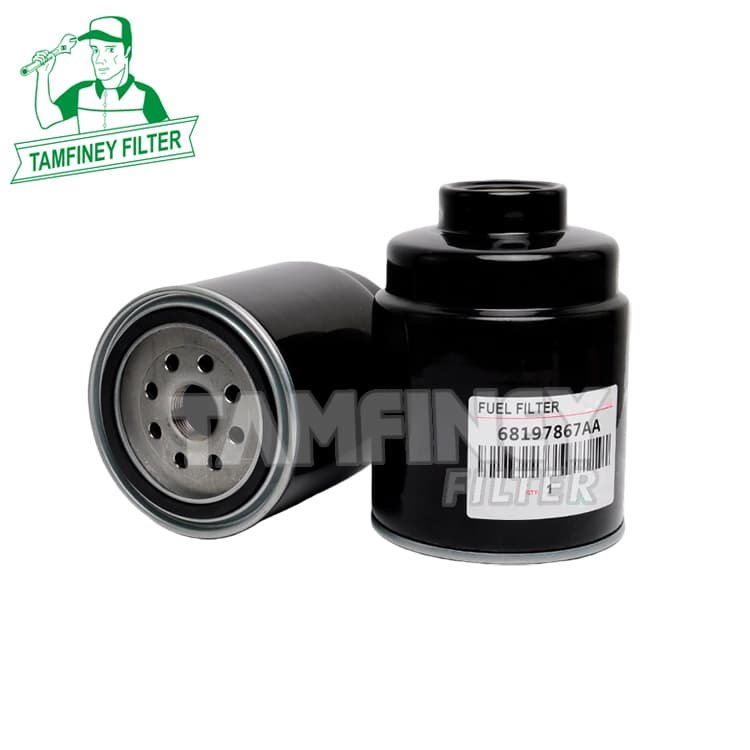
Professional Ram 5500 Fuel Filter 68197867AB 68197867AA MO-867 P551833
Your Best Ram 5500 Fuel Filter 68197867AB 68197867AA MO-867 P551833 Fuel Filter manufacturer in China.
Chrysler 68197867AB 68197867AA Mopar MO-867 Donaldson P551833


|
Fuel Filter 68197867AB 68197867AA MO-867 P551833 Parameter: |
|
| Part Number | 68197867AB 68197867AA MO-867 P551833 |
| Brand | Tamfiney |
| Weight | 598 g |
| Height | 140 mm |
| Outer Diameter | 108 mm |
| Inner Diameter/ Thread Size |
M36 x 1.5 1"-14mm |
| Minimum Order | 100 PCS |
| Place of Region: | Zhejiang, China |
| Payment Terms: | T/T |
| Price Terms: | FOB |
| Lead Time: | 30 to 50 days based on order quantities |
| Market Type: | After Market |
| Current Export Market: | Southeast Asian,North America, South America, Western Europe, Eastern Europe, Africa, Oceania |
Applications:
- DODGE
RAM 3500 6,7 D 4WD CREW CAB PICKUPRAM 4500 6,7RAM 5500 6,7
Professional Ram 5500 Fuel Filter 68197867AB 68197867AA MO-867 P551833
Q: What year of 6.7 Cummins to avoid?
There is currently no publicly available authoritative report specifying which years of the 6.7-liter Cummins engine models commonly have design flaws or high failure rates that need to be avoided. However, based on some user feedback and maintenance experience, some 6.7-liter Cummins engines produced between 2010 and 2014 (such as the ISB series) may have experienced relatively high levels of high-pressure oil pump failure, EGR system blockage, turbocharger oil leakage, etc. due to early design or manufacturing issues
If you are considering buying a used car, it is recommended to focus on the specific model of the engine, maintenance records, and actual vehicle condition, rather than just the production year. It is best to evaluate its reliability through professional testing or querying the complete maintenance history.
Q: How to prime 6.7 Cummins after fuel filter change?
After replacing the fuel filter of Cummins 6.7, these steps of inspection cannot be omitted:
1. Leak detection is the primary task
Carefully inspect all oil pipe connections, especially the interface and sealing gasket of the new filter, to ensure that there is no fuel leakage. This step is crucial as it can effectively prevent safety hazards caused by oil leakage or loose pipelines.
2. Start the test to check the status
Connect the power supply to restore oil pressure (do not start yet), and then start the engine. Observe whether the idle speed is stable, whether there is any abnormal shaking or stalling, and pay attention to whether there is any abnormal noise in the engine compartment.
3. Road test verification is more comprehensive
Conduct a short road test, focusing on testing whether the acceleration is smooth and whether there is any jerky feeling when shifting gears. After driving, stop again to check the filter and pipeline interface, and confirm that there is no leakage during the secondary leak detection.
4. System pressure check (if possible)
Measure the fuel system pressure through the diagnostic interface to ensure that the filter resistance is normal and the oil circuit pressure is stable. This is a professional means of verifying the installation effect of the filter and the sealing performance of the system.
Special attention: If it is a common rail engine, the ignition switch needs to be repeatedly turned on and off 5 times to exhaust the air. When a decrease in power or abnormal fuel consumption is detected, the filter status should be immediately rechecked.
Q: Does changing the diesel fuel filter improve performance?
Yes, replacing the diesel filter usually improves the performance of the engine.
Specifically, after replacing the diesel filter with a new one, the engine can obtain cleaner fuel, which brings the following benefits:
Enhance power output:
The filtered clean diesel ensures the normal operation of the fuel injection system (such as fuel injectors), resulting in more uniform and precise fuel injection, smoother engine acceleration, and better power performance.
Improving fuel economy:
After reducing impurities, fuel combustion is more complete, which helps to reduce fuel consumption and save operating costs.
Reduce engine wear:
Filters can effectively intercept impurities and moisture, protect precision components such as high-pressure fuel pumps and injectors, reduce wear, and extend engine life.
Ensure stable operation:
Regular replacement can avoid problems such as poor fuel supply, idle shaking, and weak acceleration caused by clogged filter elements, making the engine run more smoothly.
Therefore, regularly replacing diesel filters is an important part of maintaining engine health and maintaining its good performance.