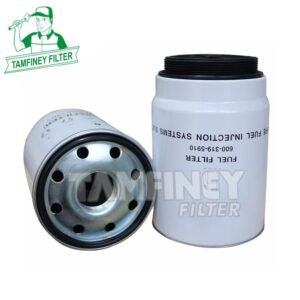

| Fuel Filter PL420 PL420/7X SFC-7939-30 Parameter: | |
| Part Number | PL420 PL420/7X SFC-7939-30 |
| Brand | Tamfiney |
| Weight | 1126 g |
| Height | 230 mm |
| Outer Diameter | 108 mm |
| Inner Diameter/ Thread Size | 1-14 S80X3 |
| Minimum Order | 100 PCS |
| Place of Region: | Zhejiang, China |
| Payment Terms: | T/T |
| Price Terms: | FOB |
| Lead Time: | 30 to 50 days based on order quantities |
| Market Type: | After Market |
| Current Export Market: | Southeast Asian,North America, South America, Western Europe, Eastern Europe, Africa, Oceania |
Applications:
FOTON AUMAN ETXBJ 4251 SLFJB-SBJ 4253 SMFKB-2BJ 4253 SMFKB-S6LG 936LG 955LG 956
JAC MOTORS HFC 4251 KR1-Y41HO
LOVOL FOTON GROUP FL 956 FFL 956 HFL 958 H
MAN D 2542 MLED 2848 LE 423D 2868 LE421 D 2868 LE 421D 2868 LE 421
Professional Mann PL420 Fuel Water Separator Filter PL420/7X SFC-7939-30
Q: What are the signs your water separator needs service?
Fuel water separator (fuel pre filter) for automotive diesel engines:
The main function is to separate moisture and impurities from diesel, and faults can cause abnormal engine operation:
Abnormal power and acceleration: The vehicle experiences weak acceleration, slow response, jerking or sudden stalling during driving.
Difficulty starting: Due to the entry of moisture into the combustion chamber affecting atomization, it is difficult to start the cold car and requires multiple ignitions.
Abnormal exhaust: Black smoke (incomplete combustion) or white smoke (water evaporates into steam) is emitted from the exhaust pipe.
Unstable idle speed: The engine speed fluctuates rapidly, the body shakes noticeably, and in severe cases, the engine stalls intermittently.
Fault light alarm: The dashboard engine fault light is on, and some models will prompt "high water level in water separator".
Increased fuel consumption: Due to a decrease in combustion efficiency, fuel consumption has significantly increased.
Q: How often should you drain or replace the filter?
Drain frequency: It is recommended to check every 2000 kilometers or during maintenance. If the fuel quality is poor or the environment is humid, the inspection frequency should be increased; When the water level reaches the warning line or the alarm light lights up, it is necessary to manually drain immediately.
Replacement frequency: It is generally recommended to replace it every 10000 kilometers, usually in conjunction with oil filter maintenance. If using inferior fuel, frequently driving in harsh environments (dusty, extremely cold), or with high vehicle workload (such as logistics, rental), it should be shortened to 8000 kilometers or replaced earlier.
Life reference: The overall service life of the components is usually around 20000 kilometers. If there is a decrease in engine power, abnormal increase in fuel consumption, or difficulty starting, it is necessary to check and replace them in advance.
Q: What is the difference between Standard Filter and Fuel Water Separator?
The primary distinction between the standard filter (typically referring to the diesel fuel filter) and the fuel water separator lies in their filtration objectives and working principles: the former primarily targets solid impurities, while the latter specializes in liquid moisture removal, often forming a multi-stage filtration system to jointly protect the engine.
• Main Functions:
Standard filter: Utilizes filter paper or fiber media to intercept solid particles (such as dust, metal debris, and gum) in the fuel, preventing injector clogging and component wear. Some models have auxiliary water-removal capabilities but it is not the core advantage.
Fuel water separator: Based on the density difference between oil and water (gravity sedimentation) or coalescing technology, it separates and deposits free water from the fuel into a bottom water collection cup, ensuring the fuel entering the engine is dry and protecting the high-pressure common rail system.
• Working Principle:
Standard filter: employs a physical sieving mechanism, where the microporous filter element blocks contaminants, with a typical filtration accuracy of 5-10 micrometers.
Fuel water separator: A physical separation mechanism where fuel flows through a diffusion cone or hydrophilic/hydrophobic material. Small water droplets coalesce into larger droplets and settle, but cannot effectively intercept tiny solid particles.
• Maintenance method:
Standard filter: Replace the entire filter element regularly; do not clean or reuse.
Fuel water separator: Regular manual or sensor-activated drainage of accumulated water is required, and the filter element should only be replaced when damaged.
Actual application relationship
In modern diesel vehicles (especially those meeting National III or higher emission standards), the two are often used in series or integrated as a single unit: the water separator serves as the first-stage coarse filter to remove water and large particles, while the standard filter acts as the second-stage fine filter for further purification. If a vehicle only lists a "fuel filter," it is necessary to verify whether it has a built-in water-separating function; if it exists independently, it must be used in conjunction to meet both the requirements of contaminant removal and water elimination.