Get a Free Quote
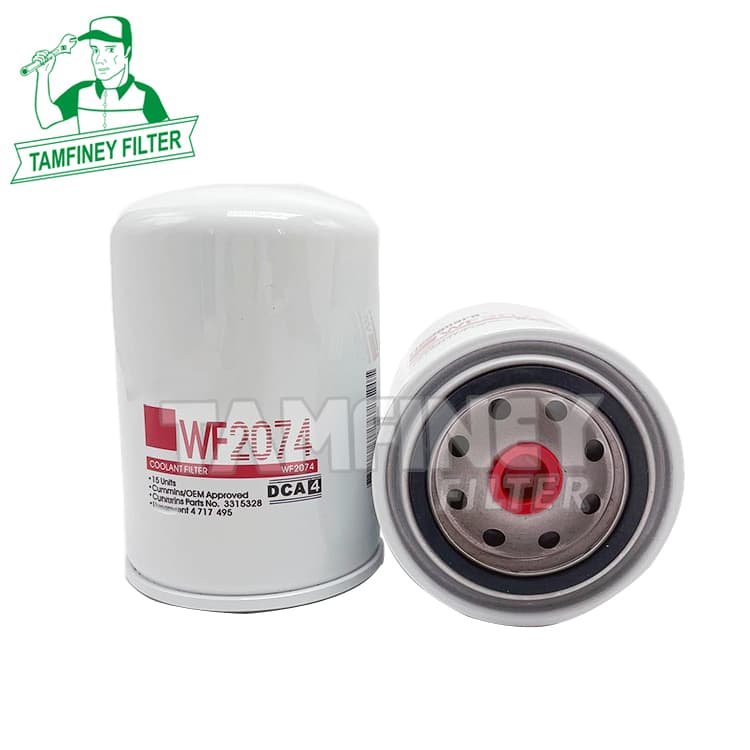
Fleetguard WF2127 Cross Reference Filter B5087 3680434 P550585 PR8694
Your best Fleetguard WF2127 Cross Reference Filter B5087 3680434 P550585 PR8694 Coolant filter manufacturer in China.
CUMMINS 3680434 Fleetguard WF2127
INGERSOLL RAND 57645202 Baldwin B5087 DONALDSON P550867 P550585 Fram PR8694 Luberfiner LFW2127


| Coolant Filter WF2127 B5087 3680434 P550585 PR8694 Parameter: | |
| Part Number | WF2127 B5087 3680434 P550585 PR8694 |
| Brand | Tamfiney |
| Height | 140 mm |
| Outer Diameter | 94 mm |
| Inner Diameter/Thread Size | M36 x 2 |
| Minimum Order | 100 pcs |
| Place of Region: | Zhejiang, China |
| Payment Terms: | T/T |
| Price Terms: | FOB |
| Lead Time: | 30 to 50 days based on order quantities |
| Market Type: | After Market |
| Current Export Market: | North America, South America, Western Europe, Eastern Europe, Africa, Oceania |
What vehicles does WF2127 fit?
CASAGRANDE B 300 XP
FREIGHTLINER ARGOSYARGOSYARGOSYARGOSY
INTERNATIONAL TRUCKS HX 520HX 620
KENWORTH T 2000T 800 B
Professional Fleetguard WF2127 Cross Reference Filter B5087 3680434 P550585 PR8694
Q: What are the Benefits of a Coolant Filter?
The coolant filter (also known as the water filter) is a key filtering component in the engine cooling system, and its main advantages are the following aspects:
• Efficient filtering of impurities: It can effectively remove dust, metal debris, chemical precipitates and other impurities in the coolant, preventing these particles from blocking the radiator waterway or wearing out key components such as water pumps and cylinder liners.
• Extend the service life of the cooling system: By suppressing scale, stress corrosion, pitting, and rusting, the internal damage of the cooling system is significantly reduced, thereby extending the service life of the engine and related components.
• Maintain heat conduction efficiency: Keep the coolant clean to ensure stable engine operation at the appropriate temperature, avoiding power loss or malfunction caused by overheating.
• Compatible with long-lasting coolant technology: Some products (such as Frega water filters) have built-in slow-release DCA additives, which can gradually release protective ingredients and support extending the coolant replacement cycle to 70000 to 140000 miles (approximately 110000 to 220000 kilometers).
• Improve system reliability: Reduce the failure rate of the cooling system. According to the Society of Automotive Engineers (SAE), about 50% of engine failures are caused by cooling system problems, and using coolant filters can effectively prevent them.
• Suitable for various working conditions: Some high-end products use corrosion-resistant 304 stainless steel filter cartridges and reinforced PC housings, with a wide working temperature range (-40 ℃ to 120 ℃), a pressure resistance of up to 300Kpa, and strong anti vibration performance.
Q: Where is a Coolant Filter Installed?
The installation position of the coolant filter (also known as the water filter) varies depending on the vehicle model and engine design, but according to authoritative public information, its typical installation position is as follows:
Generally located on the main circulation pipeline of the engine cooling system, it is commonly near the inlet or outlet of the radiator (water tank) to effectively filter impurities during the coolant circulation process.
For some commercial vehicles or specific engines (such as Cummins series), the coolant filter may be installed on the side of the engine block or near the water pump, please refer to the vehicle maintenance manual for details.
During installation, it is usually necessary to tighten until the sealing gasket contacts the surface of the filter seat, and then tighten an additional 1/2 to 3/4 turn, or follow the manufacturer's technical specifications.
Q: Do I Need a Coolant Filter for My Vehicle?
Whether a coolant filter (also known as a "water filter") is needed depends on the vehicle type, operating environment, and maintenance requirements. The following is a summary of key information:
Is it necessary to install a coolant filter?
Ordinary household cars: usually do not require specialized coolant filters. As long as the qualified antifreeze is replaced according to the manufacturer's specified cycle and the cooling system is well sealed, it can generally maintain a normal state.
Specific situations or vehicle types (such as diesel vehicles, heavy-duty vehicles, old vehicles, or use in harsh environments): Installation is recommended. The coolant filter can effectively filter impurities, prevent scale and electrochemical corrosion, and reduce the risk of cooling system failure.
Under what circumstances is it recommended to use a coolant filter?
Antifreeze has been used for too long, resulting in turbidity, sedimentation, or impurities;
The cooling system has experienced malfunctions (such as poor sealing of the water pump or damaged radiator), resulting in the mixing of metal debris or dust;
Vehicles often operate under high temperature, dusty or high load conditions;
We use long-lasting antifreeze and hope to extend its service life and enhance protection