Get a Free Quote
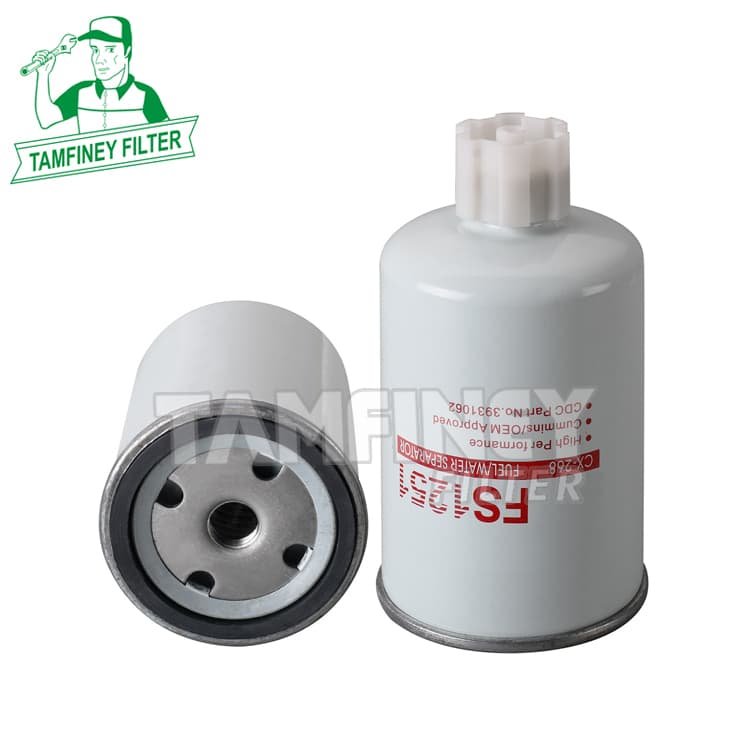
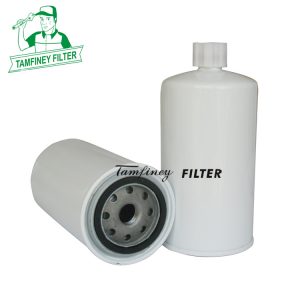
Fleetguard FS1251 Cross Reference FF4013 FS1226 F002H20308
Your Best Fleetguard FS1251 Cross Reference Fleetguard FS1251 Cross Reference FF4013 FS1226 F002H20308 Fuel filter manufacturer in China
Fleetguard FS1251 FF4013 FS1226 BOSCHF002H20308 KOMATSU 6732-71-6310 6732-71-6111 DONALDSON P550248 TATA 278609119904 MERCEDES-BENZ 940000604 RENAULT 7701030195 7701030546 7701668711 VOLVO 3134055 85105025 ONAN-1866524 ; ORENSTEIN & KOPPEL-8480286 SAKURA-FC7103 LIUGONG 53C0045



| Fuel Filter FS1251 FF4013 FS1226 F002H20308 Parameter: |
| Part Number | FS1251 FF4013 FS1226 F002H20308 |
| Brand | Tamfiney |
| Weight | 396 g |
| Height | 147 mm |
| Outer Diameter | 76 mm |
| Inner Diameter/ Thread Size |
M16 X 1.5-6H INT |
| Minimum Order | 100 PCS |
| Place of Region: | Zhejiang, China |
| Payment Terms: | T/T |
| Price Terms: | FOB |
| Lead Time: | 30 to 50 days based on order quantities |
| Market Type: | After Market |
| Current Export Market: | Southeast Asian,North America, South America, Western Europe, Eastern Europe, Africa, Oceania |
Applications:
• CASE 118818401845 C40 XT435580 K EXIGENCE580 M580 SNEAKER SERIES CMX 100MX 110MX 120MX 135MX 150MX 170MX 90PATRIOT 3150VX 200WX 170
• CUMMINS 4 T 3906 B 5.96 B 5,9 M6 BT 5.9-G26 BT 5.9-G26 BT 5,9 M6 BTA 5.96 BTA 5.9-G26 BTA 5,9 M6 BTAA 5.9-G126 BTAA 5.9-G26 C 8.36 CTA 8.3
• DAF 45.12045.13045.150 TURBO45.160 TURBO45.180 TURBO45.210 TURBO55.150 TI55.180 TI55.210 TI55.230 TIF 1000F 600F 800
• DYNAPAC CA 402CC 422CC 522
• FURUKAWA 725 W LS TRONIC730 W LS TRONIC
• GROVE A 100 JA 125 JA 80 JAMZ 106 XTAMZ 131 XTAMZ 86 XTTM 9120
• HYUNDAI H 70H 70 LGPR 120 WR 120 W-3R 130 LCR 130 LC-3R 180 LC-3R 200 LCR 200 WR 210 LC-3R 210 LL-3R 280 LCR 290 LC-3R 290 LL-3R 290 RB-3
Professional Fleetguard FS1251 Cross Reference FF4013 FS1226 F002H20308
Protecting diesel engines from contaminants and water is critical for performance. The Fleetguard FS1251 Fuel Filter Water Separator stands as a reliable choice for modern fleets. TAMFINEY provides the FS1251 and its cross reference WK842, ensuring every customer benefits from premium filtration and extended engine life.
FS1251 Cross Reference: Simplifying Fleet Maintenance
The fs1251 cross reference list includes options like WK842, enabling easy switches during servicing. This means reduced downtime and effortless sourcing, even in the most demanding schedules. Cross references maintain OEM-level protection with every replacement.
Moreover, using a cross-referenced filter like WK842 is cost-effective. TAMFINEY’s comprehensive approach simplifies procurement and enhances operational reliability.
FS1251 Fleetguard: Trusted by Professionals
Professionals in transport and construction prefer the fs1251 fleetguard filter. Advanced filtration media captures harmful particulates and separates water with high efficiency. As a result, engines experience fewer issues and improved performance over time.
Equally, Fleetguard’s strict quality standards provide peace of mind with each purchase. TAMFINEY guarantees only original FS1251 Fleetguard filters, ensuring uncompromised protection.
FS1251 Filter: Advanced Fuel Filtration Technology
With the fs1251 filter, customers benefit from state-of-the-art water separation and filtration. Its durable construction withstands high pressures and tough engine conditions. Fuel systems remain cleaner, extending the lifespan of injectors and pumps.
In addition, maintenance intervals are lengthened, saving both time and money for fleet operators. TAMFINEY supports your business with genuine FS1251 filters every step of the way.
Why Choose TAMFINEY Filters?
TAMFINEY leads with expertise and dedication in diesel filtration. Our quick response, extensive stock, and technical knowledge make us the preferred source for FS1251, WK842, and cross references. We deliver only high-quality, rigorously tested filters.
Additionally, customers enjoy professional guidance for every purchase and replacement. TAMFINEY’s mission is long-lasting engine health for all our clients.
Conclusion
To summarize, the Fleetguard FS1251 Fuel Filter Water Separator and cross references like WK842 offer effective, reliable protection. Choosing TAMFINEY ensures faster sourcing, authentic products, and expert support. Trust us to supply the right solutions—keeping your engines efficient and your business thriving.
Q: What is a fuel filter water separator?
Fuel filter water separator is a type of fuel filter mainly used in diesel engine vehicles. Its core function is to separate water and impurities in the fuel to ensure the normal operation of the engine.
The working principle of this device is mainly based on the density difference between water and fuel, using the principle of gravity settling for separation. After entering the separator, the fuel first passes through the filter layer to remove solid impurities, and then the emulsified fuel water mixture is decomposed in the demulsification layer. Small water droplets condense into large water droplets and precipitate in the collection tank, and finally discharged through the drainage valve. Internally, components such as diffusion cones and filters are usually designed to enhance separation efficiency.
The fuel water separator plays a key role in the fuel system,effectively removing moisture from diesel, reducing the failure rate of fuel injectors, extending the service life of the engine, and making fuel combustion more complete. It is usually used as the preceding stage of a diesel filter, working in conjunction with a diesel fine filter (responsible for filtering fine particles) to form a multi-stage filtration system.
Structurally, fuel water separators can be divided into two forms: external installation (located in the fuel pipeline) and internal installation (integrated into the fuel pump or tank). Separation technologies include membrane filtration, oleophilic materials, non powered separation, and emulsion breaking separation.
Q: Water Separating Fuel Filters How do they work?
The fuel water separation fuel filter is a device that integrates filtration and separation functions, mainly used to remove solid impurities, moisture, and emulsified oil from the fuel, ensuring that the fuel supplied to the engine is highly clean, thereby protecting precision components, improving combustion efficiency, and extending engine life. Its working principle is based on physical separation technology, with the core relying on differences in material density, filtration interception, and agglomeration.
Workflow and Core Steps
After entering the filter, the fuel first passes through the filtering layer (such as the inner structure of the coalescing filter element), which acts as a "gatekeeper" to intercept solid particles and impurities (such as metal shavings and dust), preventing them from entering the engine. Subsequently, the fuel flows through the demulsification layer, which can disrupt the emulsified state of oil and water, allowing the mixed water and oil to be separated again.
Next, in the coalescence layer, tiny water droplets gradually coalesce into larger water droplets through inertial collisions and van der Waals forces; Due to the higher density of water than fuel, these large water droplets settle into the collection tank under the action of gravity. For small water droplets that fail to coalesce, they are further captured by the water repellent properties of the separation filter, collected in the sedimentation tank, and regularly discharged through the drainage valve.
Key technical principles
• Density difference drives stratification: The natural stratification of water and fuel is the foundation, with water sinking and oil floating, promoting separation by extending the residence time.
• Aggregation and demulsification: The aggregation layer uses fiber materials to adsorb small water droplets and polymerize them into large droplets; The emulsion breaking layer destroys the emulsion film through chemical or physical actions, accelerating fuel water separation.
• Multi level filtration design: The filter element often adopts a multi-layer composite structure (such as coarse, fine, and ultrafine fiber stacking), which balances efficient interception and low resistance flow.
Structural characteristics and advantages
The typical structure includes components such as aluminum trays, coalescing filters, water collection tanks, and sedimentation tanks, all of which are made of corrosion-resistant materials (such as stainless steel) to ensure durability. This design can effectively handle emulsified oil and viscous water, avoiding water freezing or impurities from damaging the engine at low temperatures. It is suitable for scenarios such as diesel vehicles and heavy machinery that require high fuel purity.
Q: How A Fuel Water Separator Works?
The vehicle fuel water separator mainly utilizes the density difference between oil and water, and separates the moisture and impurities in the fuel through physical methods such as gravity settling, centrifugal force, or coalescence filter element, ensuring that the fuel entering the engine is clean and dry.
The core workflow typically includes:
1. Pre treatment: Oily wastewater is first filtered or buffered to remove large particle impurities.
2. Gravity stratification: In the sedimentation tank, oil with lower density naturally rises while water sinks, achieving preliminary separation.
3. Agglomeration reinforcement: Through corrugated plates or fiber coalescers, small oil droplets aggregate into large oil droplets, accelerating sinking.
4. Collection and discharge: The upper layer of oil is collected and discharged, while the lower layer of water is regularly discharged through a drainage valve.