Get a Free Quote
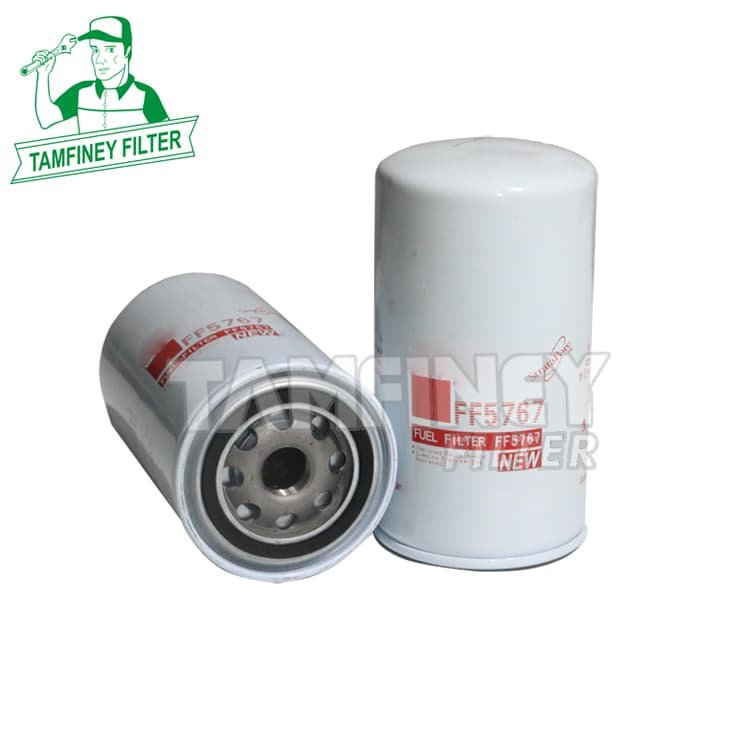
Professional Fleetguard FF5767 Cross Reference Filter BF7634 BF7815 FF5309 600-311-3750
Your best Fleetguard FF5767 Cross Reference Filter BF7634 BF7815 FF5309 600-311-3750 fuel filter manufacturer in China.
Fleetguard FF5767 FF5309 Baldwin BF7634 BF7815 Komatsu 600-311-3750



| Fuel Filter FF5767 BF7634 BF7815 FF5309 600-311-3750 Parameter: | |
| Part Number | FF5767 BF7634 BF7815 FF5309 600-311-3750 |
| Brand | Tamfiney |
| Weight | 653 g |
| Height | 176 mm |
| Outer Diameter | 93 mm |
| Inner Diameter/ Thread Size |
7/8-14 |
| Minimum Order | 100 PCS |
| Place of Region: | Zhejiang, China |
| Payment Terms: | T/T |
| Price Terms: | FOB |
| Lead Time: | 30 to 50 days based on order quantities |
| Market Type: | After Market |
| Current Export Market: | Southeast Asian,North America, South America, Western Europe, Eastern Europe, Africa, Oceania |
Application:
• KAMAZ 605106520
• MINSK AUTOMOBILE PLANT MAZ 60511
• SANY SCT 250SCT 500STC 700 T5
Professional Fleetguard FF5767 Cross Reference Filter BF7634 BF7815 FF5309 600-311-3750
The Importance of the Fleetguard FF5767 Filter
Clean fuel is essential for every diesel engine. Because fuel injectors are sensitive, any particle can cause significant damage. The Fleetguard FF5767 filter is designed for reliable filtration. As a result, your engine receives only the cleanest fuel, ensuring smoother operation. Not only does the fleetguard ff5767 boost performance, but it also extends your engine’s service life. Although there are many filters on the market, few offer the efficiency and durability of the ff5767.
Understanding FF5767 Cross Reference for Accurate Replacement
Finding the right filter sometimes feels overwhelming, especially with so many part numbers. However, using the ff5767 cross reference system simplifies identification and ordering. For example, the Fleetguard FF5767 directly cross-references with trusted numbers, including BF7634, BF7815, FF5309, and 600-311-3750. In addition, mechanics and fleet operators use these cross-references to guarantee perfect fit and function. Furthermore, these references eliminate confusion and prevent installation errors. Whenever you need assurance, always check the ff5767 cross reference before making a purchase.
Key Benefits and Features of the FF5767 Filter
Because build quality is paramount, the Fleetguard FF5767 filter uses advanced filtration media. Also, its robust construction can withstand tough engine conditions daily. Although many filters promise peak efficiency, the ff5767 filter consistently delivers superior performance. Moreover, it traps both water and harmful particles, which helps protect your fuel system. When you rely on this filter, you experience fewer engine problems and minimized downtime.
Compatibility: Cross-Reference Details for Multiple Applications
Fleetguard FF5767 is more than just a single-part solution. In fact, it’s compatible with a range of equipment brands and engines. Not only does it match FF5309 or BF7815, but it also suits those needing BF7634 or even 600-311-3750. Because accurate fit is essential, always consult the cross-reference list before ordering. Besides, suppliers like TAMFINEY can guide you through every step.
Installation and Maintenance Tips
Although filter replacement looks simple, attention to detail ensures optimal results. First, gather the correct ff5767 filter or its cross reference. Then, read your engine’s manual for step-by-step installation help. During replacement, always inspect seals and gaskets. If you find any wear, replacement is essential. After installing the new filter, bleed the fuel system to prevent airlocks. Because regular maintenance helps catch problems early, it also extends engine lifespan. Moreover, using Fleetguard FF5767 or trusted cross-references guarantees sustained performance.
Why Choose TAMFINEY for Your FF5767 Filter Needs?
TAMFINEY is committed to delivering quality fuel filtration solutions. Not only do we offer the Fleetguard ff5767 filter, but we also stock equivalents like BF7634, BF7815, and FF5309. Furthermore, our catalog contains hard-to-find parts, including 600-311-3750. Because customer satisfaction matters, TAMFINEY ensures fast shipping and professional support. In addition, our filters undergo rigorous quality checks. Whether you manage a fleet or operate a single machine, TAMFINEY’s reliable supply reduces downtime.
Conclusion: Rely on Fleetguard FF5767 and TAMFINEY for Peace of Mind
In summary, the Fleetguard ff5767 is an outstanding solution for diesel fuel filtration. With comprehensive cross-references like BF7634, FF5309, and others, choosing the right filter is simple. Moreover, regular maintenance with quality products increases engine reliability and efficiency. Because TAMFINEY understands every customer’s need for quality and support, we make finding and purchasing the ff5767 filter easy. For trusted filtration, quick shipping, and expert service, always choose TAMFINEY as your supply partner.
Q: What is equivalent to FF5767?
CUMMINS 3959612 GMC 6439164
KOMATSU 600-311-3750
600-319-3750
HYUNDAI 11LB-70020
ATLAS COPCO 3222310756
3222-3107-56
GENERAL MOTORS 89002405
BALDWIN BF7530-MPG BF7632 BF7634 BF7815 BF7917
DONALDSON P171421 P551314
FLEETGUARD FF5309 FF5767
Cummins 5366433 5301448
FLEETGUARD FF5321 FF5324 FF5488
MANN-FILTER WK 850/3
ATLAS COPCO-5580006639 Doosan K1008143
Q: Which is better, a 20 micron or a 50 micron filter?
Filtering accuracy and applicable scenarios
20 micron filter element: With high filtration accuracy, it can intercept smaller particles such as fine sediment, rust, or colloids. Suitable for areas with poor oil quality and high impurities, or for situations where high oil clarity is required. But high precision may lead to increased resistance and require more frequent replacement.
50 micron filter cartridge: The filtration accuracy is relatively low, mainly intercepting larger particles (such as sediment and suspended solids), with higher flux and smaller pressure loss, suitable for better oil quality or as a pre filter. The replacement cycle is usually longer and the maintenance cost is lower.
Selection suggestion
If the water quality is turbid or contains a lot of small impurities, a 20 micron filter can provide more effective filtration.
If pursuing high flow, low maintenance frequency, and good oil quality, a 50 micron filter may be more economical and practical.
Q: Does a higher micron filter better?
Does a higher micron rating mean better filtration performance? The answer is not absolute; it depends on the specific application and requirements. The micron rating (e.g., 25μm or 40μm) represents the smallest particle diameter that the filter can intercept. A lower value indicates higher filtration precision but may also bring other effects.
The Basic Principles of Filtration Precision
• The smaller the micron rating, the finer the filtration: For instance, a 25μm filter element can intercept finer impurities (such as fine sand, rust, pollen, and insect eggs), while a 40μm filter primarily targets larger particles (like silt and rust clumps). Higher precision theoretically results in more thorough filtration, but it also increases oil flow resistance, which may lead to reduced oil pressure or more frequent clogging of the filter.
• Actual Filtration Effect Variance: Under identical conditions, a 25μm filter element may achieve a retention rate exceeding 99.16%, effectively removing more fine contaminants. However, if the oil quality is superior (e.g., with fewer impurities), a 40μm filter element is sufficient to meet daily operational requirements.
Advantages and Disadvantages of High-Precision Filters
• Advantages: Can intercept finer impurities, enhance oil safety, and is particularly suitable for scenarios with poor oil quality or high oil quality requirements
• Drawbacks: Greater oil flow resistance may affect oil pressure; higher maintenance frequency is required due to the filter element's tendency to clog, necessitating more frequent cleaning or replacement. For instance, a 25μm filter may clog more quickly in environments with high impurity levels, leading to maintenance challenges.
How to choose the appropriate micron number?
• Prioritize oil quality: If the raw oil contains a high level of impurities (such as sand or rust), a high-precision filter (e.g., 25-40μm) is more effective; if the oil quality is good, a low-precision filter (e.g., 40μm) can suffice and requires less maintenance.
• Balancing filtration efficiency and practicality: Micron rating is not the sole determining factor; it must also consider filter media, design (such as anti-gravity flow channels), flow rate, and other factors. For instance, certain 25μm filters optimize flow channel design to reduce clogging risks while maintaining precision and oil pressure.
In summary, filter elements with higher micron ratings theoretically offer better filtration, but the actual choice should be made based on a comprehensive evaluation of oil quality, usage habits, and maintenance costs. For those seeking ultimate filtration, high-precision products are suitable but require more frequent maintenance; for those prioritizing practicality, medium-precision filter elements may be more appropriate.