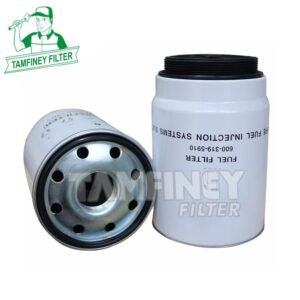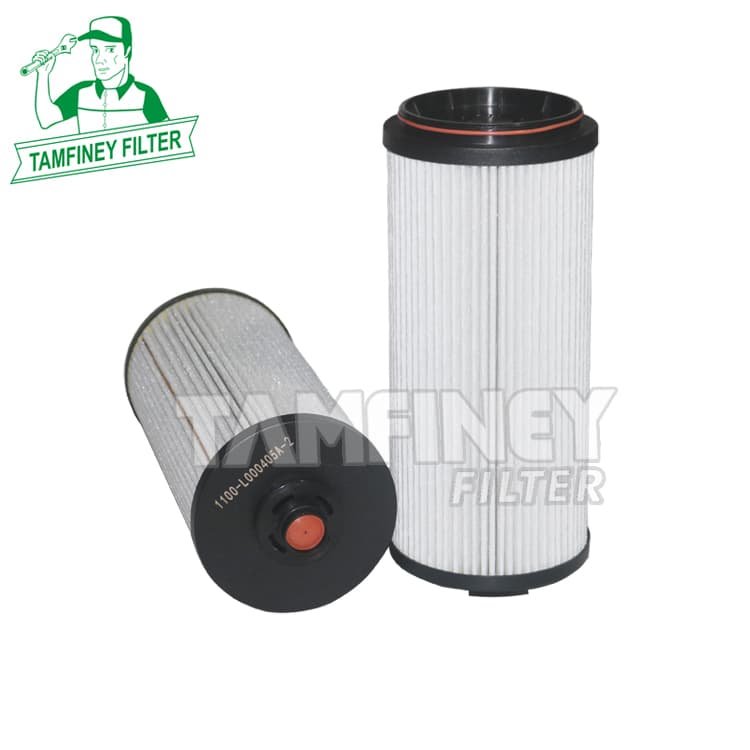



| Diesel Water Separator Filter 1100-L000405A-2 160603010047A001 Parameter: | |
| Part Number | 1100-L000405A-2 160603010047A001 |
| Brand | Tamfiney |
| Weight | 712 g |
| Height | 237/262 mm |
| Outer Diameter | 108 mm |
| Inner Diameter/ Thread Size | |
| Minimum Order | 100 PCS |
| Place of Region: | Zhejiang, China |
| Payment Terms: | T/T |
| Price Terms: | FOB |
| Lead Time: | 30 to 50 days based on order quantities |
| Market Type: | After Market |
| Current Export Market: | Southeast Asian,North America, South America, Western Europe, Eastern Europe, Africa, Oceania |
Applications:
• Genlyon
Professional Diesel Water Separator Filter 1100-L000405A-2 160603010047A001 for Genlyon
In the realm of diesel engine maintenance, Diesel Water Separator Filters play a pivotal role. These filters are designed to protect engines from water contamination, ensuring longevity and peak performance. TAMFINEY, a leader in filtration solutions, offers high-quality options tailored for diverse industrial applications.
Why Choose TAMFINEY’s Diesel Water Separator Filters?
TAMFINEY’s 1100-L000405A-2 and 160603010047A001 models stand out for their efficiency. Specifically engineered for Genlyon systems, they excel in removing water and impurities from diesel fuel. Consequently, this prevents engine corrosion and reduces maintenance costs. Moreover, their durable construction ensures reliable operation in harsh conditions.
Transitioning to benefits, these filters enhance fuel combustion efficiency. By eliminating water, they minimize harmful emissions, aligning with environmental regulations. Additionally, they improve engine responsiveness, which is critical for heavy-duty machinery. As a result, businesses experience fewer downtime issues and lower operational expenses.
Key Features and Applications
The Diesel Water Separator Filter range from TAMFINEY integrates advanced materials. For instance, the 1100-L000405A-2 model features a high-capacity design, ideal for large-scale industries. On the other hand, the 160603010047A001 variant is compact, perfect for space-constrained installations. Both models are compatible with Genlyon engines, offering seamless integration.
Furthermore, these filters are easy to install and maintain. With user-friendly designs, they reduce labor costs during replacement. Transitioning to reliability, they undergo rigorous testing to ensure consistent performance. Therefore, they are trusted by professionals in construction, agriculture, and transportation sectors.
Enhancing Performance with TAMFINEY’s Solutions
TAMFINEY’s commitment to innovation drives its Diesel Water Separator Filter offerings. By focusing on quality and precision, the company delivers products that exceed industry standards. For example, the for Genlyon series is tailored to meet specific engine requirements, optimizing fuel purity.
In conclusion, investing in TAMFINEY’s filters is a strategic decision. They not only safeguard engines but also enhance overall system efficiency. Whether for industrial or commercial use, these filters provide a cost-effective solution. Embrace TAMFINEY’s expertise and elevate your diesel operations today.
Q: How often do you drain a diesel water separator?
If the water separator (or oil-water separator) is not drained, the moisture cannot be effectively separated and discharged, which may cause a series of negative impacts on the vehicle system. Below is a summary based on relevant information:
Engine Performance Degradation: When moisture enters the engine, it may lead to incomplete combustion, resulting in engine shaking, weak acceleration, reduced power output, and even white smoke (a manifestation of water vapor combustion).
Oil contamination issue: The presence of water in the engine oil can cause emulsification (turning the oil into a milky, viscous substance), which reduces lubrication performance, accelerates wear on components such as piston rings and cylinder walls, and may also increase oil consumption.
Component Corrosion and Carbon Buildup: Prolonged presence of moisture can promote carbon buildup inside the engine, clogging fuel injectors or valves, and may also cause corrosion of metal components, shortening the engine's lifespan.
Emissions and Safety Risks: Incomplete combustion of the air-fuel mixture may result in excessive exhaust emissions (such as black smoke). In extreme cases, moisture entering the combustion chamber could lead to engine failure or sudden stalling, compromising driving safety.
Impact of Other Systems: If the separator malfunction involves the air detection device or vacuum pump system, moisture may corrode sensors or pipelines, leading to inaccurate detection results or equipment damage.
It is recommended to regularly inspect and drain the water separator to prevent these issues from worsening. If the vehicle exhibits abnormal symptoms (such as increased fuel consumption or insufficient power), prompt repairs should be conducted
Q: How does a diesel water separator filter work?
The working principle of diesel water separator filters (usually integrated into diesel filters) is mainly based on physical separation methods, using the density difference between water and diesel, the adsorption characteristics of filter materials, and multi-stage filtration technology to remove moisture and impurities from fuel. The following is its core working process:
1. Primary filtration (mechanical screening):
Diesel first enters the primary filtration layer of the filter, which uses high-density filter paper to intercept larger particle impurities with a particle size greater than 10 microns through screening effect. These pores are like fine sieves, directly filtering out obvious large particle pollutants.
2. Secondary filtration (adsorption and aggregation):
Diesel that has undergone primary filtration enters the secondary filtration layer, which may use materials such as felt, polymer composites, or activated carbon. These materials further remove small particles and colloids through adsorption. At the same time, tiny water droplets and impurities in diesel collide and aggregate on the surface of the filter material through Brownian motion, increasing the apparent diameter and making it easier to filter out.
3. Fuel water separation (density difference and gravity settling):
The filter is designed with an oil-water separation device inside, which utilizes the density difference between water and diesel (water is heavier) to achieve separation. When diesel flows through separation elements such as diffusion cones and hydrophobic materials, water sinks due to gravity, while diesel rises, thus achieving preliminary oil-water separation. Some designs also incorporate hydrophobic materials to actively repel moisture and enhance separation efficiency.
4. Precision filtration and monitoring:
The high-end model is equipped with electronic sensors to monitor the water accumulation status of the filter element in real time. When the moisture content exceeds the threshold, the system will trigger an alarm to prompt the user to drain the water in a timely manner to prevent moisture from entering the engine. Modern filters may also use nano coated filter materials to improve dust holding capacity and service life.
Function and significance:
This filter can effectively remove moisture, particulate matter, and gum from diesel, prevent nozzle blockage and engine wear, especially for high-pressure common rail diesel engines, which can improve combustion efficiency and extend engine life.
It should be noted that different vehicle models or application scenarios (such as industrial oil-water separators) may use additional technologies such as cyclone separation and membrane filtration, but the above principles are the core of automotive diesel water separators.
Q: What happens if you don't drain a water separator?
If the water separator is not emptied, it will cause the oil-water mixture to accumulate continuously in the equipment, leading to a series of problems. The specific impact varies depending on the application scenario, and the following are common situations:
The impact on car performance
If the water separator of a car (usually used for diesel engines) is not drained in time, water and impurities will accumulate, leading to the following problems:
• Insufficient fuel combustion: Water entering the engine combustion chamber can prevent complete combustion of fuel, resulting in decreased power output, weak acceleration, and a feeling of shaking or weakness while driving.
• Increased risk of engine damage: Moisture may cause corrosion and wear of engine components, and even lead to difficulty starting and stalling, which can shorten the engine life in the long run.
• Fuel system blockage: Accumulation of impurities may clog components such as fuel injectors, causing uneven fuel injection, increased fuel consumption, or carbon deposition issues.
The impact on the catering industry or industrial equipment
In catering kitchens or industrial wastewater treatment, if the water separator is not emptied, it will bring more extensive consequences:
Environmental pollution: Oil and impurities are directly discharged into water bodies, forming an oil film that hinders oxygen dissolution, harms aquatic organisms, and disrupts ecological balance.
Pipeline blockage and equipment damage: Oil and grease condensation can easily block drainage pipelines, leading to sewage backflow; At the same time, it may damage subsequent sewage treatment equipment (such as biological treatment tanks).
Economic losses and penalties: Additional cleaning costs are required for pipeline blockages, and fines may be imposed for non-compliance with environmental standards (such as fines ranging from usd700-7000 for failure to install or maintain oil-water separators in catering establishments), and even orders to shut down for rectification.
Health and safety risks: Accumulation of oil pollution can easily breed bacteria and pests, produce odors, and affect environmental hygiene and customer health.
General fault manifestations and suggestions
Failure to drain the oil-water separator may also cause equipment malfunctions, such as:
• Decreased separation effect: Oil stains are not discharged in a timely manner, resulting in the treated water still containing oil or grease, or excessive water content in the oil. six
• Equipment blockage or leakage: Solid impurities may accumulate and block the inlet or oil discharge pipeline, requiring regular cleaning and maintenance. sixty-eight
Suggestion: Both automobiles and industrial equipment should regularly drain the oil-water separator according to the instructions and inspect components such as filters and valves to avoid the above problems. If faults are found (such as poor drainage, odor, etc.), they should be repaired in a timely manner.