Get a Free Quote
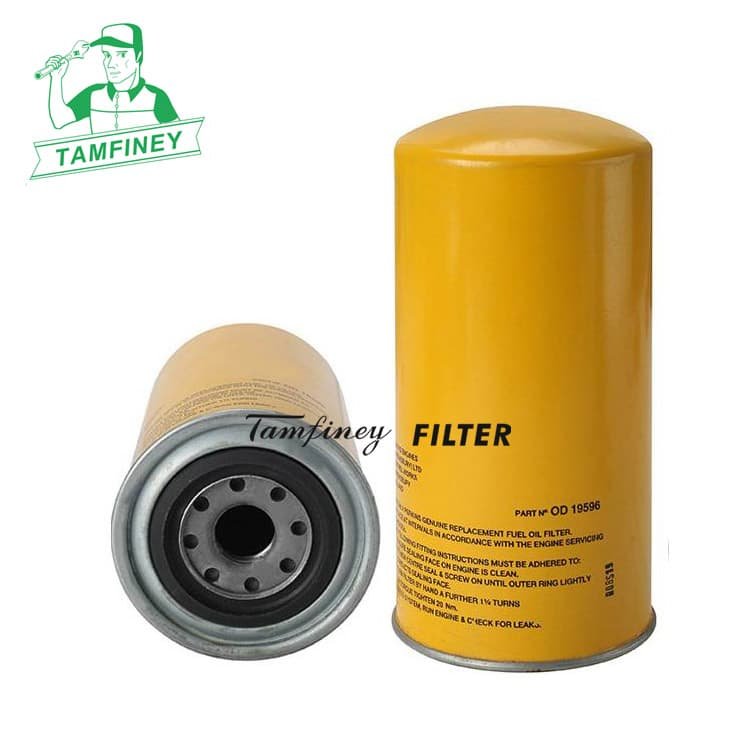
Professional Diesel Engine Filters FF4036 BF1102 LFF4036A P550365 OD19596
Your best Diesel Engine Filters FF4036 BF1102 LFF4036A P550365 OD19596 Fuel filter manufacturer in China.
DONALDSON P550365 P779430 J8620596 BALDWIN-BF1102 ERF 1356836 ,ROD19596 ,ROE47449 FLEETGUARD-FF4036 ; FORD-5011307 ,A830X-9150-MA FRAM-P4106B KUKJE-YGT00156 ; DAF-RROE46045 LINDE-3562229015 PERKINS-OD19596 OE42873 POD19596 OE19596 OE46045 OE47449 Lancer Boss 8932411, SAKURA-FC5110 SDMO-330560191 GMC 89002866 LUBERFINER LFF4036A LFF4036A


| Fuel Filter FF4036 BF1102 LFF4036A P550365 OD19596 Parameter: | |
| Part Number | FF4036 BF1102 LFF4036A P550365 OD19596 |
| Brand | Tamfiney |
| Weight | 590 g |
| Height | 192 mm |
| Outer Diameter | 94 mm |
| Inner Diameter/ Thread Size |
M24 X 1.5-6H INT |
| Minimum Order | 100 PCS |
| Place of Region: | Zhejiang, China |
| Payment Terms: | T/T |
| Price Terms: | FOB |
| Lead Time: | 30 to 50 days based on order quantities |
| Market Type: | After Market |
| Current Export Market: | Southeast Asian,North America, South America, Western Europe, Eastern Europe, Africa, Oceania |
Application:
HIMOINSA HSW 400 INS
PERKINS 12 HD 610 T2006 TAG 22006 TTAG2006 TWG 23008-TAG 13008-TAG 23008-TAG 33012-TAG 13012-TAG 23012-TAG 33012-TWG 13012-TWG 28 HD 400 TC 6.220C 6.305C 6.350CONDOR CV 12CONDOR CV 8CV 12-400 GCV 12-450 G
ROLLS ROYCE CV 12-400 GCV 12-450 G
SDMO GS 800PW 650 K
WILSON P 330P 360P 425P 500P 600
Professional Diesel Engine Filters FF4036 BF1102 LFF4036A P550365 OD19596
Q: How often should diesel fuel filters be replaced?
The replacement cycle of diesel filters is generally 5000-10000 kilometers or 100-200 hours, but it needs to be flexibly according to the quality of the oil, driving environment, and filter type.
🔧 Reference for regular replacement cycle
1. External filter (chassis installation, such as the old Volkswagen Lavida and Toyota Corolla):
Replace every 15000-30000 kilometers or 1-2 years.
If you frequently refuel at small gas stations or drive on dusty roads, shorten it to 10000-12000 kilometers.
2. Built in filter (fuel tank integrated, such as BMW 3 Series, Honda Civic):
Replace every 40000 to 100000 kilometers or 2-3 years.
For high-end models such as BMW, it is recommended to advance to 30000 kilometers.
⚠️ These situations require a shortened cycle
• Poor fuel quality: Long term use of non-standard gas station fuel or inferior diesel can shorten the cycle by 30% (such as from 10000 kilometers to 7000 kilometers).
• Poor environment: dusty, sandy or construction site sections, shortened to 5000-8000 kilometers.
• Vehicle symptoms: Replace immediately if there is weak acceleration, idle shaking, sudden increase in fuel consumption, or difficulty starting.
Replacement precautions
1. Operation safety: The built-in type requires professional disassembly of the fuel tank to avoid fuel leakage or electric shock risks.
2. Check signal: If the color of the filter element noticeably turns black (such as dark brown), it is a sign of pollution and must be replaced.
Synchronous maintenance: Check the sealing ring together during replacement to prevent oil leakage.
Q: What are the different filters in a diesel engine?
The filters used in diesel engines are have three categories: air filters, oil filters, and fuel filters, which together protect key engine systems from impurities.
The air filter is installed at the front end of the intake system to filter out dust and particulate matter in the air, prevent internal wear of the engine, and ensure combustion efficiency.
The oil filter is located in the lubrication system and continuously filters metal debris and pollutants from the engine oil, providing clean lubricating oil for moving parts and reducing friction losses.
The fuel filter is specifically designed to handle impurities in diesel, including particulate matter, moisture, and gum. Its structure is commonly rotary or replaceable, which can effectively protect precision components such as fuel injectors; According to functional segmentation, it can also be divided into oil-water separators (to remove moisture and prevent rust) and fine filters (to filter small particles such as 3-5 microns). Some models also integrate a hand pump for exhaust. These filters work together and are crucial for maintaining the performance, lifespan, and emission control of diesel engines.
Q: Can I use the same filter for both gasoline and diesel?
The filters for gasoline and diesel cannot be used interchangeably.
The reason is that there are fundamental differences in the physical and chemical properties and engine system requirements between gasoline and diesel. Diesel has a high viscosity, and the engine fuel system contains precision components such as fuel injection pumps, which require more stringent cleanliness requirements. Therefore, diesel filters are usually designed with multi-stage filtration (such as coarse and fine filtration) to effectively remove small particles, moisture, and gum; Gasoline filters are generally single-stage filters that focus on preventing blockages in carburetors or fuel injectors. In addition, the filtration accuracy, pore size, flow requirements, and installation interfaces (such as thread specifications and cup diameter) of the two types of filter cartridges are often different. Even if the appearance is similar, low filtration efficiency or installation problems may occur due to mismatched internal parameters.
Incorrect use may lead to serious consequences. If a diesel filter is used in a gasoline engine, insufficient flow may cause a decrease in fuel supply pressure, resulting in insufficient engine power or stalling; On the contrary, using gasoline filters in diesel engines may accelerate the wear of precision components and even cause system failures due to insufficient filtration accuracy. Therefore, specialized filters must be selected based on the vehicle engine type (gasoline or diesel) and the manufacturer's recommended model.