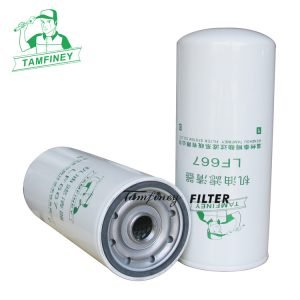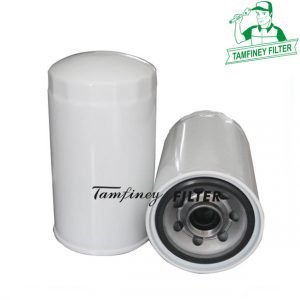


| Cellulose Filter LF558 H1072/1 5S-484 16Y-752-3200 Parameter: | |
| Part Number | LF558 H1072/1 5S-484 16Y-752-3200 |
| Brand | Tamfiney |
| Weight | 895 g |
| Height | 234 mm |
| Outer Diameter | 100 mm |
| Inner Diameter | 44 mm |
| Material | Metal & Paper |
| Filter Media | High-efficiency pleated cellulose / synthetic fiber blend |
| Typical Working Pressure | Up to approx. 6–10 bar |
| Filtration | Approx. 5–10 micron |
| Temperature Rating | Up to approx. 100–120°C |
| Minimum Order | 100 PCS |
| Place of Region: | Zhejiang, China |
| Payment Terms: | T/T |
| Price Terms: | FOB |
| Lead Time: | 30 to 50 days based on order quantities |
| Market Type: | After Market |
| Current Export Market: | Southeast Asian,North America, South America, Western Europe, Eastern Europe, Africa, Oceania |
Applications:
KOMATSU 4 D 1304 D 130.1D 50 AD 50 PD 50 PLD 50 S 16D 53 AD 53 PD 53 S 16D 55 S-3S 4 D 120S 4 D 130S 4 D 155
Professional Cellulose Filter LF558 H1072/1 5S-484 16Y-752-3200
Q: Are cellulose filters good?
Cellulose filter is a highly practical filter with outstanding advantages in most conventional scenarios, but there are also some usage limitations that need to be noted.
✅ Core advantages
- Wide coverage of filtration accuracy: The cellulose membrane version can achieve 100% bacterial filtration, and the deep layer version can also achieve a 98% bacterial interception rate, effectively removing impurities such as rust, sediment, colloids, etc. Some models also have a certain removal effect on large molecular organic matter.
- Low comprehensive usage cost: Cellulose raw materials have good processing performance and relatively low cost. In industrial scenarios, solid waste can be reduced by about 80%, significantly reducing comprehensive operating costs.
- Environmentally friendly and biodegradable: The cellulose filter can degrade waste naturally, and some cellulose filter papers that have undergone special processing can directly decompose into single fibers for recycling.
⚠️ Shortcomings to be noted
- Short maintenance cycle: filter cartridges usually need to be replaced every 3-6 months, and the cost of consumables for long-term use needs to be included in the budget in advance.
- Part of the working conditions are difficult to recycle: cellulose filter paper is difficult to recycle and reuse after being contaminated with oil, and most can only be burned as fuel or sent to landfills.
Q: What is a cellulose filter made of?
The core material of cellulose filters is based on cellulose derivatives, and different types of products will be matched with different auxiliary structural materials. The specific composition is as follows:
Core filter material
- Basic cellulose derivatives: mainstream cellulose membrane filters, the core filter material is composed of nitrocellulose, cellulose acetate, or a mixed cellulose ester made from both, which is the core part for achieving high-precision interception of bacteria and particulate matter.
- Composite functional filter material: Carbon fiber filter cartridge type cellulose filter, made of cellulose and activated carbon powder composite, with dual functions of physical interception and adsorption of odors and organic matter.
- Natural cellulose material: Experimental cellulose extraction sleeves and other products are directly processed from high-quality cotton cellulose, and some specially modified products use natural cellulose materials such as wood pulp and plant fibers.
Auxiliary structure and shell material
- Support and shell: The shell and skeleton of industrial grade cellulose filters are mostly made of 304 stainless steel or ABS engineering plastic to ensure the structural strength and corrosion resistance of the equipment.
- Composite reinforcement layer: Some high-precision folded filter cartridges will add an additional glass fiber filter layer, paired with stainless steel end caps to enhance overall structural stability and filtration accuracy.