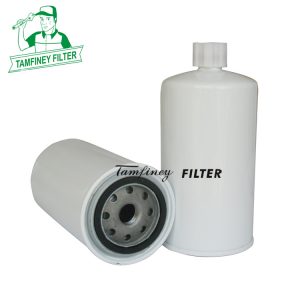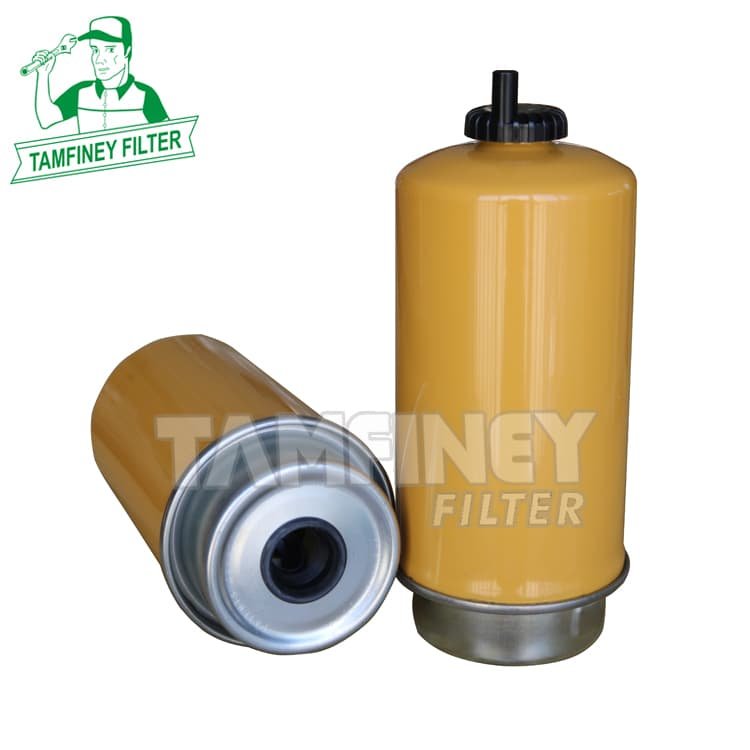



| Fuel Filter 228-9130 FS19981 WK8148 WK8170 2289130 Parameter: | |
| Part Number | 228-9130 FS19981 WK8148 WK8170 2289130 |
| Brand | Tamfiney |
| Weight | 350 g |
| Height | 83 mm |
| Outer Diameter | 200mm |
| Inner Diameter/ Thread Size | 23mm |
| Minimum Order | 100 PCS |
| Place of Region: | Zhejiang, China |
| Payment Terms: | T/T |
| Price Terms: | FOB |
| Lead Time: | 30 to 50 days based on order quantities |
| Market Type: | After Market |
| Current Export Market: | Southeast Asian,North America, South America, Western Europe, Eastern Europe, Africa, Oceania |
Application:
CATERPILLAR 416 E420 E424 D424 D428 F432 E432 E2432 F
JOHNSTON SWEEPERS
MAGNI RTH 5.18RTH 5.21RTH 5.23RTH 5.25RTH 5.30
VOLVO MC 110 CMC 115 CMC 135 CMCT 125MCT 125 C
Professional Caterpillar 3054 Fuel Filter 228-9130 FS19981 WK8148 WK8170 2289130
Q: What does 228-9130 do?
228-9130 is a fuel filter or fuel water separation filter used in construction machinery (especially Caterpillar/CAT equipment), mainly used to filter moisture and impurities in fuel to protect the engine and improve operating efficiency.
• Core function: As a fuel filter or fuel water separation filter element, it can separate the moisture in the fuel and filter out small particles.
Applicable equipment: Widely used in construction machinery such as Caterpillar excavators, loaders, tractors, etc., and also suitable for equipment from brands such as New Holland.
• Typical application scenarios:
Pre filtration in diesel/fuel systems;
Prevent moisture from entering the engine and causing corrosion or poor combustion;
Improve fuel cleanliness and extend engine life.
• Key technical parameters (information from different suppliers):
Filtration accuracy: 10 microns;
Applicable media: fuel, diesel, and aqueous mixtures
Q: Can I clean and reuse a pre filter?
The majority of modern vehicles' fuel pre filters are not recommended to clean and reuse, and should be replaced directly according to the maintenance cycle.
If some special-purpose vehicles (such as diesel generators and construction machinery) are with washable filter elements (such as metal mesh or wound wire), they can be reused after cleaning, but they must strictly follow the operating specifications.
Paper/disposable filter cartridges are mainstream:
The vast majority of cars on the current market (especially mainstream brands such as Japanese, German, American, etc.) use paper filter elements for fuel filters, which have precise structures and small pores, and are used to filter particles larger than 3-5 microns. Once impurities are adsorbed, it is difficult to completely restore the filtration performance through cleaning, and it is easy to damage the filter paper or sealing structure, leading to filtration failure and even engine damage.
Manufacturers generally require replacement rather than cleaning:
Most vehicle maintenance manuals explicitly state that fuel filters are disposable consumables and recommend replacing them every 20000 to 40000 kilometers.
Cleanable filter element is limited to specific types:
A few industrial or older engines (such as some diesel engines) may be equipped with metal mesh, wound or centrifugal pre filters, which allow for disassembly, diesel cleaning and reuse after being dried with compressed air. However, ordinary household cars rarely adopt such structures.
Q: What does a pre filter remove?
The fuel pre filter is the first filtering barrier in the fuel system, mainly used for preliminary purification before the fuel enters the main filter or high-pressure common rail system. You can remove some impurities:
• Moisture (water): This is one of the core functions of a pre filter, especially crucial for diesel engines. By using oil-water separation techniques such as gravity settling, coalescence demulsification, etc., free water mixed in the fuel is separated and collected in a settling cup or drain valve for discharge.
• Large particle impurities: including suspended solids such as iron oxide, dust, sediment, and colloids, with particle sizes usually larger (such as>5 μ m), which can be intercepted by the coarse filter layer.
• Some small particles: Some high-performance pre filters use multi-stage composite filter materials, which also have a certain ability to capture small particles of 3-5 μ m, but the main fine filtration task is completed by subsequent fine filters.