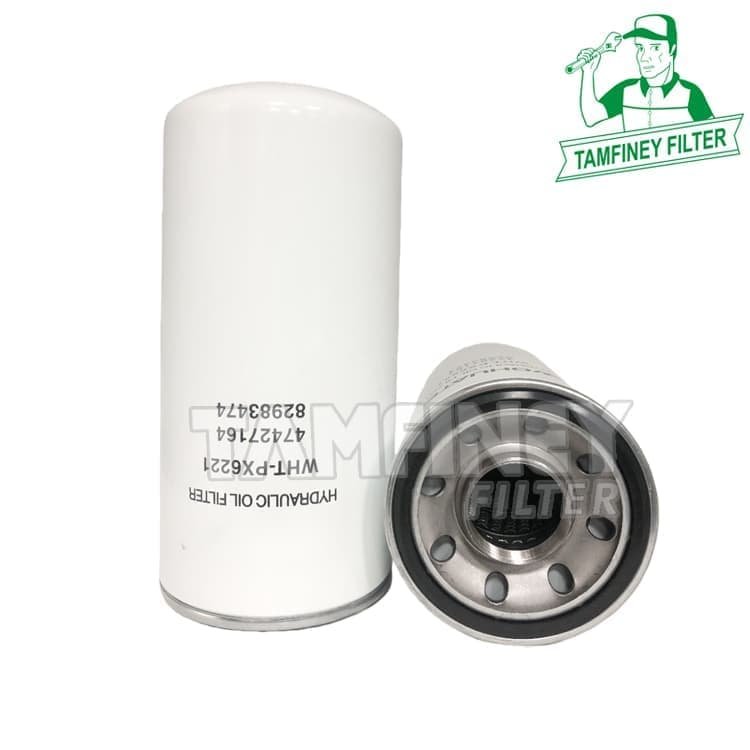



| Hydraulic Filter 47427164 P551364 HF35518 BT9439 82983474 Parameter: | |
| Part Number | 47427164 P551364 HF35518 BT9439 82983474 |
| Brand | Tamfiney |
| Weight | 1568 g |
| Height | 260 mm |
| Outer Diameter | 118 mm |
| Inner Diameter/ Thread Size | 1 3/4"X16 |
| Material | Metal & Paper |
| Filter Media | High-efficiency pleated cellulose / synthetic fiber Paper |
| Casing | Painted steel outer body with perforated steel internal support |
| Typical Working Pressure | Up to approx. 6–10 bar |
| Filtration | Approx. 5–10 micron |
| Temperature Rating | Up to approx. 100–120°C |
| Minimum Order | 100 PCS |
| Place of Region: | Zhejiang, China |
| Payment Terms: | T/T |
| Price Terms: | FOB |
| Lead Time: | 30 to 50 days based on order quantities |
| Market Type: | After Market |
| Current Export Market: | Southeast Asian,North America, South America, Western Europe, Eastern Europe, Africa, Oceania |
Applications:
New Holland TB110, 6610S, 7610S, 8010, and related Case Construction machinery
Professional Case 47427164 Pressure Filter P551364 HF35518 BT9439 82983474
Q: How does a pressure filter work?
The core principle of pressure filtration is to use pressure to "squeeze" the liquid through the filter cloth, trapping solid particles and achieving solid-liquid separation. The entire process can be understood as a cycle of several steps, including clamping, feeding, filtering, and unloading.
🏭 workflow
- Filter plate closure: Hydraulic or motor-driven compression plates press multiple filter plates in sequence, forming a sealed filter chamber between the plates.
- Feed filtration: The feed pump pressurizes the slurry or material slurry into the filter chamber, and the liquid is discharged through the filter cloth. Solid particles are intercepted and gradually accumulate into a filter cake.
- Squeezing and Dehydration: The diaphragm filter press injects high-pressure water or compressed air into the diaphragm to further squeeze out moisture from the filter cake.
- Unloading: After filtration is completed, the filter plate automatically opens and the filter cake falls off by its own weight.
- Filter cloth cleaning: Rinse the filter cloth with high-pressure water to remove residual particles and prepare for the next round of operation.
🔧 key component
- Filter plate and filter cloth: The filter plate provides support and filtrate channel, while the filter cloth is the core filter medium, and the pore size determines the size of intercepted particles.
- Compression mechanism: manual, mechanical or hydraulic methods to ensure the sealing between filter plates without leakage of slurry.
- Rack: composed of thrust plates, compression plates, and beams, supporting the entire equipment.
⚠️ Note
- The higher the filtration pressure is not the better. Excessive pressure may damage the filter cloth or block the pores.
- The feeding speed should be uniform and controllable, as being too fast or too slow can affect the filtration effect.
- The filtrate may become turbid in the initial stage and become clear after a filter cake forms on the filter cloth; If it remains cloudy, it may be due to damage to the filter cloth or deviation in the hole position
Q: What are the main types of pressure filters?
🔩 Classification by Pressure Level
Suitable for industrial pipeline systems under varying pressures.
- Low-pressure filter: up to approximately 60 bar.
- Medium-pressure filter: up to approximately 210 bar.
- High-pressure filter: up to approximately 450 bar.
- Special Filter: Up to 1000 bar.
⚙️ Classification by Structural Form
The structure determines the installation method and maintenance characteristics.
- Y-type filter: Simple structure and low cost, suitable for water and steam pipelines, prone to clogging when impurities are abundant.
- T-type filter: The filter element can be easily extracted by removing the cover, making it suitable for pipelines with space constraints and frequent maintenance needs.
- Basket filter: Large filtration area and high dirt-holding capacity, commonly used at pump inlets and in high-flow systems.
- Stacked Filter: Composed of stacked plates, its principle is similar but functions are focused differently.
Bag Filter: Easy to replace filter bags with virtually no material consumption during filtration.