
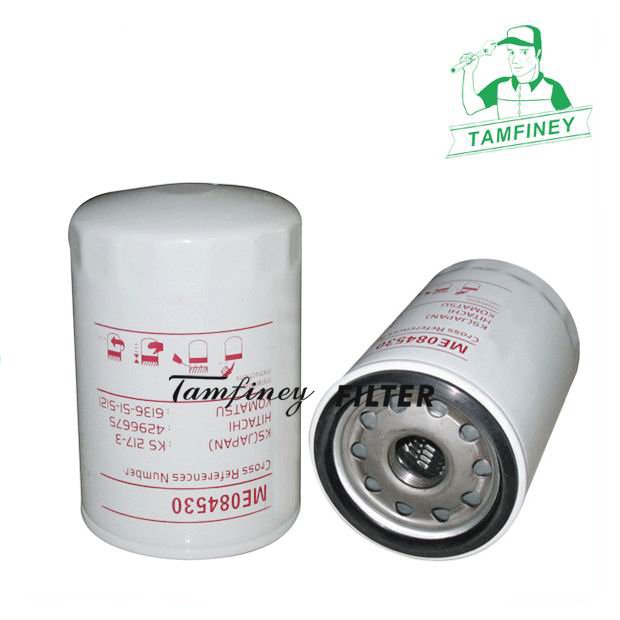



| Oil Filter P559128 P556007 LF3565 C-1505 C1505 C-1009 Parameter: | |
| Part Number | P559128 P556007 LF3565 C-1505 C1505 C-1009 |
| Brand | Tamfiney |
| Weight | 823 g |
| Height | 147 mm |
| Outer Diameter | 107 mm |
| Inner Diameter/ Thread Size | 1"-1/8x16 |
| Minimum Order | 100 PCS |
| Place of Region: | Zhejiang, China |
| Payment Terms: | T/T |
| Price Terms: | FOB |
| Lead Time: | 30 to 50 days based on order quantities |
| Market Type: | After Market |
| Current Export Market: | North America, South America, Western Europe, Eastern Europe, Africa, Oceania |
What vehicles does P559128 fit?
RATRAC 3700 CFSTURBOTRAC 260
ROLBA TURBOTRAC 260
VOLVO-PENTA MARINE TAMD 71 ATAMD 71 B
WILLIBALD MZA 2500
WIRTGEN SF 1300 VC
Performance 5 Micron Oil Filter P559128 P556007 LF3565 C-1505 C1505 C-1009
Q: Which is finer for oil filter, 10 or 20-micron?
A 10 micron oil filter element offers finer filtration than a 20 micron one.
It captures particles 10 microns or larger, including tiny metal debris and dust.
This provides superior cleaning protection for the engine.
A 20 micron filter primarily blocks particles 20 microns and above.
Its ability to filter small impurities is relatively limited.
Q: Which is better for oil filter, 5 micron or 20-micron?
There is no absolute "better" choice between a 5-micron or 20 micron oil filter, the key is whether it matches your vehicle's engine type and operating requirements. Choosing too high precision may lead to increased oil flow resistance, while too low precision cannot provide sufficient protection.
The following are suggestions for different car models:
Turbocharged engines or high-performance models: prioritize 5-20 microns
Turbocharged engines operate at high temperatures and high speeds, requiring extremely strict cleanliness of the engine oil. Smaller impurities, such as metal debris, can cause wear and tear on precision turbochargers and internal engine components.
5 microns: Belonging to the high-precision or ultra precision level, it can filter out the vast majority of small particles, providing ultimate protection for high-performance engines, and is an ideal choice for high-end turbocharged models.
20 microns: Belonging to medium to high precision, it achieves a good balance between filtration effect and oil circulation, and is the recommended and mainstream choice for the vast majority of turbocharged models. It can effectively protect the engine while avoiding insufficient oil supply caused by thin filter elements.
Natural aspiration engine or ordinary household car: 20-40 microns is more suitable
The working environment of ordinary naturally aspirated engines is relatively mild, and the impurity particles produced are relatively large.
20 microns: For most ordinary household cars, a filtration accuracy of 20 microns is completely sufficient to effectively intercept harmful impurities in engine oil and extend engine life.
40 microns: For some economy models or cost sensitive users, a 40 micron filter can also meet basic needs, but its protection is slightly inferior to 20 microns.
Summary and Recommendations
- Turbocharged vehicles: 20 microns is the optimal balance point, and 5 microns is a higher level of protection.
2. Naturally aspirated vehicles: 20 microns is a high-quality choice, and 40 microns is the basic guarantee.
Blindly pursuing "finer is better" may actually backfire.
In short, for the vast majority of vehicles, 20 microns is an excellent choice with wide coverage and balanced performance. If you are driving a high-performance turbocharged car, 5 microns can provide top-notch protection, but 20 microns is also sufficient.
Q: Is a higher micron filter better?
Not sure. The 'better' filter depends on the specific application scenario, not the size of the micron value. The micrometer number represents the filtering accuracy, and the smaller the value, the finer the filtering; The larger the value, the coarser the filtering.
High micron (such as 5 microns) filters: more suitable for coarse filtration or pre-processing scenarios. It can effectively intercept visible or coarse impurities such as sediment, rust, pollen, and large dust, protect downstream precision equipment, and is not easily blocked. It has a long service life (usually 6-12 months) and low cost.
Low micron (such as 1 micron) filter: It belongs to fine filtration and can capture finer particles, such as some bacteria (about 2 microns for Escherichia coli), colloidal substances, smoke, and some PM2.5 particles. However, due to its small pore size, it is more likely to be blocked by small impurities and has a higher replacement frequency (usually 3-6 months).
Key conclusion:
- The 5-micron filter element is a "coarse sieve" that is suitable for removing obvious impurities and is the first line of defense for many systems.
2. A 1-micron filter element is a "fine sieve" used to improve filtration quality and is often used as the second fine filter.
3. In practical applications, the two are often used in combination: first, use a 5-micron filter to remove large particles, and then use a 1-micron filter for fine purification. This not only ensures effectiveness, but also extends the life of the fine filter, achieving a balance between economy and efficiency.
Therefore, whether to choose a higher micron or lower micron filter should be determined based on the filtration target and system requirements, rather than simply believing that a larger value is better.


